Gestation speed

The germ of the idea for Timeslip (or whatever--as I've mentioned, I'm trying to come up with a better title) came to me while I was a participant at the Rio Hondo workshop in the hills above Taos, NM in May of 2010.  Several other people had submitted sections of YA novels, and I thought "hey, maybe I can do that!"

I got up early one morning and drove off to take a hike by myself.  As I walked, the character and basic structure of the book came to me.  By the time I ran into too much snow to keep going, I had enough to get me started: my main character Doug, his father, and the device his father has invented to get into other worlds with other histories, the device that brings someone from one of those other worlds into ours, and gets Dad kidnapped.

Later that year, my family and I spent a week in the Adirondacks. Every morning I got up early and did experiments with the book. That's the way I get through the initial planning of a novel.  I pick some possibility and examine its implications, and its downstream consequences. I wouldn't say that's an efficient way to do it, but I don't have the gift of distinguishing fruitful possibilities from sterile ones. I have to take each one out for a fairly extensive test drive. I sat out on the porch, feeling the light grow over Long Lake while the family slept, and scribbled in what is now the first of a thick series of notebooks lined up near the desk where I write this.

The first draft went fairly quickly, by my standards, and I had it done by September of 2011.  Why, then, did I only manage to turn the thing in in September 2013?

Partly, it's because I'm an idiot. Or, to put in a way that is both nicer and more accurate, I have an "uneven cognitive profile" -- #6 in this quick essay on procrastination, by an online advice-giver, Dr. Alice Boyes, whom I've really gotten useful advice from. In many situations, my cognitive strengths allow me to skip over the things I don't do well.  But a novel, or a really busy job (as I have right now), sometimes exposes very real blindspots that I need deal with. Let's call that my UCP problem. Finding a way to detect the blindspots before they cause real problems is the main task of my self-analysis.

And partly it is that fact that I do work full time, at a job that requires a lot from me, and am my family's main financial support.  But that might account for one year of the delay, not two.

Despite my best "fruitful alternative" planning, I often end up in a narrative dead end.  I'm not particularly adept at working out complex plots with lots of competing parties, and yet, those are the plots I tend to favor.  Why not an entertaining picaresque, where one thing happens after another, and aside from a few coincidental meetings with characters from earlier in the narrative, there is no plot to speak of? I dunno.  The inspirations for those just don't seem to come to me.

So I ended up stuck several times, and had to work my way back out. I rewrote it, gave it to the Cambridge SF Workshop a year ago, and they gave me some useful advice.  Then, as often happens, I had too much to think about and fumbled and procrastinated. Was that wasted time, or useful gestation? Some of both. I did get a much stronger last third as a result.  Still shouldn't have taken so long.

On the topic of novel revision, the best advice I've found anywhere comes from writer Holly Lisle: her blog post How to Revise a Novel. Her ruthless scene-by-scene analysis really brings every problem out into the open. Now that I have incorporated her advice into my practice, I'm hoping it will percolate back into the actual scene construction, making the book "revision ready" in the first draft.

As I said, I'm hoping.

But, you know what?  I like this book a lot. I read every word while proofreading and line-editing this last time, and actually felt good about it. That's rare. Writing a younger protagonist, and striving for simpler language, forced me away from my love of imagery, background information, and complex language and into a sparer, more dramatic style.  I'm not giving any of those up, by the way. But I hope that when I revisit them in another book, I can use them because I want to, not because I need to in order to make up for other deficiencies.

It's Sunday morning.  I want to write a few stories before I start my next book. So, I will press "publish", get another cup of coffee, and get to it.

Done. Now what's the title?

Last night I wrote that I was almost done with editing my latest novel.  Now I actually am done.

I've been talking about this one for a while.  It's a YA novel about a teenager whose father invents a way to cut through to alternate histories--and then someone comes in through from one of these alternate worlds, kidnaps Dad, and disappears. I just reread every word of the thing without cringing.  I hope that's a good sign.

The problem now is the title.  It's working title all the way along has been Timeslip. But, as my writing workshop pointed out, it's misleading. It's not about time, its about worlds.  My friend Steve Popkes has pushed strongly for Crossworld. There are merits to the suggestion, but there's an evangelical tinge to the term, as you can see from this organization.

I like getting "World" in there. But putting that word first, as in Worldslip, crams too many consonants together. The same problem dogs my actual favorite alternative Worldswap. That's probably why this simple combo has never been used as a book title, as far as I can tell.  Crossing Worlds has been used once, but for a historical novel, not an alternate world adventure, so that's a possibility.

I often get stuck at this point. I want a title that lets the reader know at least a bit about the book.  IF anyone has any votes or suggestions, I'd be glad to hear them.

Teetering on the brink

For the past few months, I have been revising my next novel, a YA alternate history adventure.  At least the character is adolescent, and the language is simple, but I'm not sure it fits the current model of bonding-against-dystopia YA fiction.

And for the past couple of weeks, I've been doing a detailed proof and clean, and resisting the urge to do any deeper editing. As they say, no book is ever finished, just abandoned, and sweet noises this one makes, I'm leaving it on someone's doorstep soon.

And I'm a day or two from submittable version. It's been a long haul, my job has been stressful, and I'm in a frazzle.  What will I do when it's done? I'm not really sure.

Genre and non-neurotypicality

Last week I discussed genre, as, in part, a contract between writer and reader, reader presenting an itch, writer agreeing the scratch it. Writers who then refuse to scratch, but instead provide something they claim is vastly better, often fail dramatically.

Believe me, the sales figures for Brain Thief, a humorous cultural critique disguised as a science fiction novel, demonstrate what happens when readers expect one thing and get something else. Remember, if you click that link, you have been warned.

But, taking a step back, think about readers. Think about fans. Think about science fiction fans. A curve showing SF fan personalities, in terms of rationality, sociableness, intelligence, ability to read inner mental states from outwards signs of expression and posture, whatever you want, will show a skew in a certain direction. We are not as others are.

Well, our mean is not as other means are, at least.  Clearly there's a huge overlap, now matter how you try to sort. But that's enough of a skew to establish an audience that tends to have a certain itch. Science fiction, the genre, evolved, as a set of conventions, tropes, and customer types that works to scratch it. And those SF fans talk to each other, form communities, write back and forth, and define their itches in ever more detail.

I doubt any other genre has a fan base that skews this far from the mean.  Of all genres, SF is the most genre-y. Violate its dictates at your peril.

As I said, I know whereof I speak.

Genre, again

As usual, when I was at Readercon a few weeks ago, there were panels on genre, and, again as usual, the highly literary panel participants viewed genre with suspicion and disdain, wondering at how restrictive genre definitions are.

Just as you can't analyze rising healthcare costs without looking at jobs, you can't analyze genre without looking at readers.  But if you sit in on these panels, you'll invariably hear a lot of discussion (don't get me wrong: intelligent and thoughtful discussion) about what the writer does, how the writer achieves effects, what the writer wants to convey. The reader, both individually and en masse, gets short shrift (BTW, I just looked up this term I've been using much of my life, and discover it refers to a shortened form of last rites, or shriving, used at busy and time-crunched Elizabethan executions: "Chop chop, buddy, there's people waiting." So not only are we executing our readers, we're doing it on the cheap.)

But I think I'm getting distracted. This is the genre of blogpost, which rewards a good subject line and a tightly focused, pithy couple of paragraphcs on a specificy topic. Genre will keep me focused. In genre there is strength.

OK. Too late for pithy. What is genre? I presume there a million definitions or descriptions.  There are a few ways of looking at it, some of which I might explore at some point.  Let me just list one here.

Genre is a contract between a reader and a writer. The reader agrees to give up some portion of a limited lifespan in return for some entertainment of a certain defined type from the writer. Genre defines the kind of entertainment. The writer violates this contract only at peril, and can succeed only by giving way more than the reader expected, while simultaneously scratching the same itch the original genre was going to scratch.  This is key to successful genre violation by a clever writer: it has to satisfy the original need, only in a different and unexpected way. 

Say the reader sits down to read a good mystery, one that reveals all sorts of things about a specific milieu the reader is unfamiliar with, puts characters under stress so that they reveal things they would rather keep hidden, and, at the end, unites all sorts of disparate and seemingly contradictory observations with a single explanation. Instead, the writer shows how all the events were caused by a combat between angels and demons.

I don't care if the writer has provided Paradise Lost. The contract has been grossly violated. Even if the reader believes in angels and demons, this isn't why they are here. That isn't why money was transfered. That isn't why time was set aside to be spent. And the original itch, the tension and resolution of a mystery, has not been scratched.

So that's why when Milton sits on a panel and says "Yeah, I called it The Chancel Mystery, but I gave those ungrateful wretches Paradise Lost, for heaven's sake. Why are they bitching?"

Genre allows us to determine which itch is being scratched. And, sure, there is an itch for "deeply perceptive literature". But even people who like deeply perceptive literature usually also like a brisk well-written mystery, or a romance, or a space opera too, depending on their mood, the number of unstressed brain cells available, and whether they're at the beach or in their best reading chair.

 So, sure, genre can be a straitjacket to a writer longing for some flexibility. And these distinctions can be determined by marketing, rather than inner reader needs. Still, before writers get all bent out of shape about genres, they need to see whether they've been holding up their end of the contract.

Me and Readercon

A couple of months ago, my wife Mary scheduled me for a family reunion in Indiana--the same weekend as Readercon. I notified Readercon that I could not attend.

Then a family health problem cancelled the reunion.  So I will be at Readercon after all, but as a paying guest, not a program participant.  If you want to find me, I will have no cool ribbons or anything and will have no fun quote for Meet the Prose on Friday night.

I hope to see you there.

The plight of the secret teacher's pet

SF has a lot of tropes, that is, standard plot devices, character types, or backgrounds that are used to move stories forward.

A genre is itself just a trope writ large, so it should come as no surprise to find that SF is completely trope-ridden. It's not a bug, its an exoskeletal alien.

I've been trying to read more SF, particularly in its short forms, than I usually do. The result is a kind of queasy feeling of getting overstuffed with tropes.

One I've encountered a couple of times recently is what I call the "secret teacher's pet". You can read that as the pet of the secret teacher, or the teacher's pet who is a secret. It works either way, or, rather, both are true simultaneously.

This is how it works. The protagonist is in a school or other training situation. Since the vast majority of the readership is still in school, this is a background with some emotional heft. The protagonist is too smart, too mercurial, too virtuous, or too dedicated to fit into the normal training program. After various dramatic failures, protagonist is going to wash out and have to leave in disgrace.

Only, guess what? The protagonist's very failure to master the approved curriculum of the school is what marks him or her as someone appropriate for a higher level of training. The ugly duckling becomes a swan.The class clown becomes the teacher's pet.

To me there is something unsastisfying in the idea that the point is to appeal to a level of administration above the one you normally encounter. But appealing to the administration is still the point of the exercise. As in Gnostic sects of Late Antiquity, outer practices delude the untrained, and only initiates understand the inner truth. Gnostics were a lot more like cliques of high school mean girls than most people who idealize them as an alternative to Christianity are willing to admit.

The story gets extra points if the protagonist is young, and manages to get the crusty old instructor to throw her head back and laugh at the protagonist's impudence, just as the protagonist is sure he is going to be thrown out of school. Just getting her to laugh isn't enough. Head back, or no points. I'm a tough grader.

I suppose now that I've gone off on it, I'm going to have to write a story using this particular trope. That's a way of learning where it gets its power, and maybe putting a bit of a spin on it. But I'm not making any promises.


Do second weddings count?

As you might  know, I'm a big fan of the BBC radio show In Our Time, which I get as a podcast and listen to while running. The most recent show, on the invention of radio, contained a discussion about how little credit Marconi ever gave to anyone else, among other personality flaws, and included this exchange:

Simon Schaffer: This is a man whose best man at his wedding was Mussolini.

Elizabeth Bruton (quickly, seeking to set the record straight): Second wedding.


Panoramas and viewsheds at Gettysburg

Here, (via The Dish) an interesting interactive article by Anne Kelly Knowles, from The Smithsonian, showing what commanders could and couldn't see during crucial points during the Battle of Gettysburg. It's really fun, and well worth a look.

We're used to seeing God's-eye-views of battlefield diagrams which show everything, and also know how things worked out, so we get a skewed sense of what it was like then.

The article shows panoramas, which lets you scan across a generated image of what the battlefield actually looked like from a commander's point of view. Of course, it is devoid of concealing smoke and mist, as well as time pressure, noise of detonations, and constant influx of frantic written and spoken messages.

In addition, you can examine viewsheds, which show the map with blind areas from the commander's point of view. You can see how at crucial points, Lee had no way to see significant parts of the Union force. Of course, he did not need to rely solely on his own eyesight: he got those aforementioned frantic messages.

Still, walking through the battle using this tool gives you a real sense of the blindness that was inherent to the technological level at which any of these battles were fought. You just couldn't see anything. How did the best commanders integrate all the information thay had into a simulation of what they concluded was out there? It's an interesting form of mental processing, and clearly only a few of them were really good at it.

The graph that shows why healthcare costs aren't coming down

Via Derek Thompson of the Atlantic:

Employment Growth in Healthcare Industries

I've said it before, and I'll say it again: unless you understand healthcare provision as a jobs engine, you don't understand what's driving it. Yes, look at ridiculous billing practices, unnecessary procedures, gold-plated equipment purchases, etc. All those are important. But not as important as jobs.

Thompson says non-healthcare job growth over the past 10 years has been....0.2 percent per year.  Yow! Most of my employment over the past decade has been healthcare-related, and now I can see why.

And many of these jobs, whether physician assistant, front-desk staff, coding, home health aide, are a route up for immigrants and the people from non-professional backgrounds. They've replaced manufacturing jobs as the way to make it.

So, when you want to cut healthcare costs, take a look at the interests you'll be challenging, and realize that your job is even harder than you thought.

Of course, healthcare-cost pundit is yet another growth profession in this expanding healthcare economy.

Waterworks

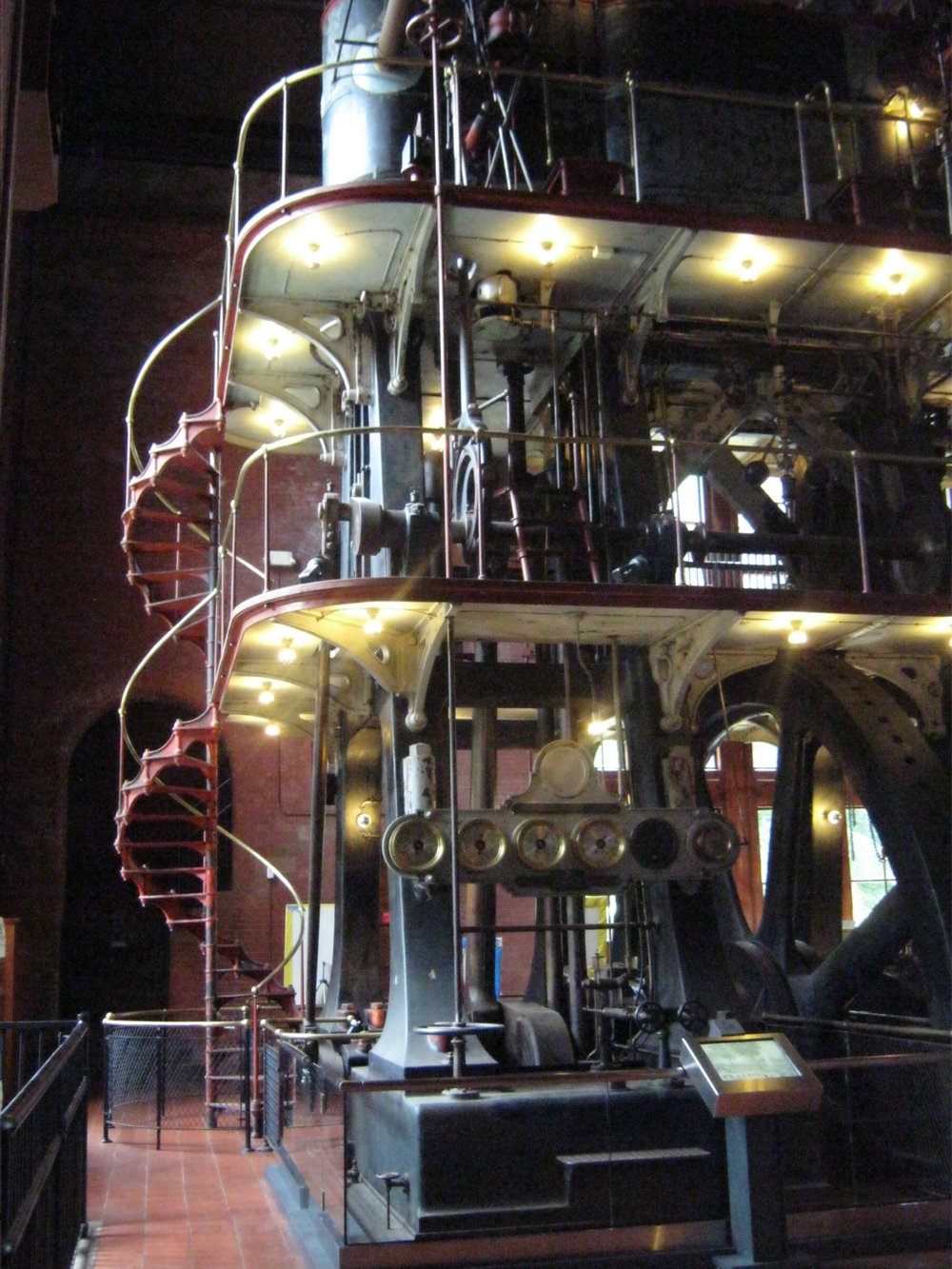
Thanks to a suggestion from reader John Redford, this weekend I took a bike ride over to the Metropolitan Waterworks Museum in Chestnut Hill, Boston, for a look at some heroic public works.

If you like Richardsonian Romanesque public buildings containing some behemoth steam engines, all spruced up and ready to go, this is the place for you.

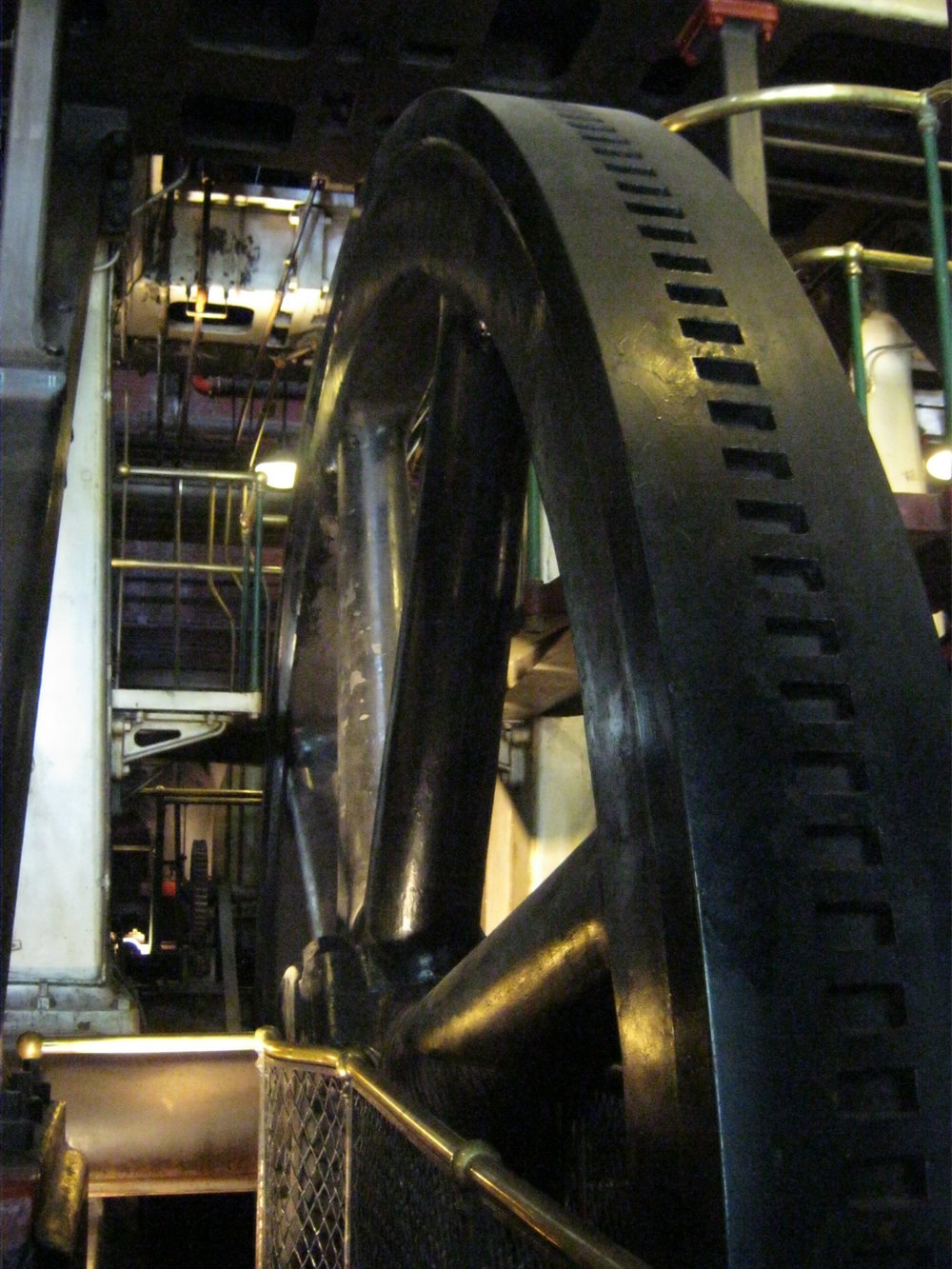
Quite the popular style, until suddenly it wasn'tBut it's what inside that makes this place great.  Three multistory steam engines, two of them triple expansion, which means they have three cylinders, each one larger than the previous one, since it works on the lower-pressure exhaust of the first. At the far end is the newest engine, the Allis:

This is just the bottom of the thing.Another viewDid people spend a lot of time protesting "Big Steam"? Yeah, they did.View from the balconyI went by myself--not a lot of people like hanging out in places like this. And I had it almost entirely to myself.  It also has some thoughtfully designed display screens with animated cutaway diagrams of the various engines. Great fun.  Thanks for the suggestion, John.

Buzzkill in the NY Times

Today's Science Times had two nannyish articles, in the category of "it's 'science' if it gives you evidence that makes you behave in a more socially useful way".

First was "Designated Drinkers" (I don't see it online). Apparently occasionally the "designated driver" in a group has a drink early in the evening.  A study showed that 65% of those identified as designated drivers had no alcohol in their blood, 17% had .02 to .049%, and 18% had .05 "or higher" (the article coyly refused to say how high, but did not indicate that anyone was actually over the legal limit). Legal limit is .08.  The study's author announced that designated driver campaigns were "ineffective".

There's a lot of impairment out there, from sleepiness to texting to OTC medication. Alcohol in small doses is also an impairment. According to this calculator, I would reach .02 by drinking two beers in a three hour period.  I know that "two beers" is the standard unit of theoretical consumption for anyone, no matter how much they actually drank.  I'm talking about an actual two beers. Three hours.

Second "science" story: "Turn Off or Leave Running?", a horror-filled story about the dangers of running a dishwasher or charging a cell phone overnight. It mentions a dishwasher-related death, presumably this one.

When the rules are so restrictive that you can't follow them, what use are they? If you can't charge your cell phone overnight, when do you do it? How much attention should you pay to your dishwasher?

I always thought my life was pretty mundane, but knowing the risks I run daily, I am feeling like more a thillseeker.

Release of The Other Half of the Sky

Today is the official publication date of Athena Andreadis's and Kay Holt's anthology of space opera stories featuring strong female characters, The Other Half of the Sky.  I'm pleased that my story "Bad Day on Boscobel" is one of them.

Aside from me, the anthology includes stories from Melissa Scott, Nisi Shawl, Sue Lange, Vandana Singh, Joan Slonczewski, Terry Boren, Aliette de Bodard, Ken Liu, Alex Dally MacFarlane, Martha Wells, Kelly Jennings, C. W. Johnson, Cat Rambo, Christine Lucas, and Jack McDevitt.

Reviews and interviews about the anthology.

Some long ago reading: House of Rain, by Craig Childs

When I was in Moab a few months ago, after my hike through the Maze, my friend Paul and I stopped by the wonderful Back of Beyond Books on Main Street and I picked up a copy of House of Rain, by Craig Childs. It is about the Anasazi, whose territory we had been hiking through. I meant to write about it then, but it has been sitting on my desk since, and it's about time it moved from there to the shelf where it belongs.

Ah, that term, "Anasazi". Paul was immediately suspicious. It's an obsolete term, no longer used by the up-to-date.  It refers to the inhabitants of the Colorado Plateau before about the thirteenth century. The more correct term nowadays is "Ancestral Puebloans".

This change is more than political correctness, by the way, though one is always suspicious of rectification of the names. The name Anasazi was given to the ruins by Navaho pothunters, and means something like "enemy ancestors": Navaho are relatively recent on the plateau, and part of a complex system of alliance and hostility.

Childs has a nuanced defense of his use of the term. I won't go into it, because I know the real reason he used it: marketing. It's a totally cool name, and nothing else even comes close. Technical correctness, if you can achieve such a thing, has to run a distant second to that.

The books is half history and half Childs' strenuous and, to be frank, intimidating travels through the plateau, riding cloudbursts, climbing cliffs, enduring bitter cold and brutal heat.

And he travels with eccentrics and obsessives, people who think the Anasazi (let's stick with that, understanding its limitations) did everything in pairs, or people who think they extended far outside of the territory usually assigned to them, or laid out travel routes across hundreds of miles.  Even as he goes on trips with these guys, and ably explains their theories, its pretty clear that Childs thinks they are cracked.

And Childs tries to boost the Anasazi as some transcendent notion, some way of living and perceiving that remained as a constant through the centuries.

Maybe. I tend not to be romantic about these things. Anasazi are interesting because they left picturesque stone ruins in some of the most dramatic landscapes on the planet. They make great photographs, and a great thing to come upon during a hike. And they did this in what is now the United States, so they get a lot of push from the National Park Service.

Does that make them interesting in some deeper sense? Well...no. Childs does his impressive best, and the book is a fun read, but if you think it will tell you something significant, you're wrong. There are many peoples in the world, and many interesting ways of living, and the Anasazi, finally, are just one of them.

But this is one of those situational books. Hanging out having a beer in Moab? Hiking through Grand Gulch, visiting Mesa Verde or Chaco, climbing down from Maze Overlook? Thent his is the book you want. It will make you feel you are doing something other than just being a tourist or a hiker. It may not have the same resonance at home.

Today's lockdown: have we given something up by assenting?

This morning, as I was getting ready to get on my bike to go to work, I got a robocall from the City of Cambridge. It told me to stay home today. There had been gunfire, and a suspect from the Boston Marathon bombing was being hunted. I don't remember if the message used the phrase "shelter in place", previously unknown to me but now utterly familiar.

I let my coworkers know that I would be working from home today, and went to check out what was going on.  There were a lot of updates, serious-looking police telling me to stay in my house, and helicopters and Humvees. Later, the governor closed down Boston as well. Pictures of normally busy intersections devoid of people and cars proliferated.

As far as I know, what happened is a couple of guys set off bombs at a popular event, killing three people and injuring a number more. Later, they robbed a convenience store, killed a security guard, and got into a gunfight with some cops. One was killed, the other fled, and may or may not be under siege in Watertown, the next town over from Cambridge.

That's all bad. But is it bad enough to shut down an entire metropolitan area? The immediate area of anything going on, sure. Even a fairly large area.  But all of Boston? Bombings are not unusual in American history, including Haymarket in 1887, Wall Street in 1920, LaGuardia in 1975. Bombs are relatively easy to make and hard to protect against. Ditto guns and other weapons.  What makes this situation different enough to require this level of response?

Smart, dedicated people can cause a lot of damage if they want to. They can kill people, sometimes a lot of people. But their danger is limited to what they themselves can do. They are not all-powerful. Now, I might not know things. There might be evidence of a much larger conspiracy. We might all actually be in danger.

Or this could be ass-covering security kabuki writ large. If so, I'm going to be irritated. To be clear: I am not minimizing the danger to the police and other forces pursuing a dangerous fugitive. But proportionality is important. Otherwise I should just huddle in my basement and never leave.

Two forces are at play here, I think. One is just the sheer mass of information, useful, useless, and misleading, that pours out of our communication devices. The other is the increasing power of the security state, which accurately represents our own willingness to trade freedom for some perceived safety.  Together, they allow a couple of killers to hold an entire city hostage.

If I had just ignored the shelter order, what would the consequences have been? Could I have been restrained in some way? It is genuinely astonishing that places like Downtown Crossing and Harvard Square were completely empty just because authorities told us we needed to stay home.

Again, as I said, it might have actually been necessary. I would not have wanted to get in the way of some essential operation.  But, as you can tell, I have my doubts. Someone is going to have to explain this to me.


The rise of the obsessive redhead

Mary and I have been watching the the AMC series The Killing. We tend to have different viewing habits, but we're both enjoying it a lot.

One thing struck me with the first episode, though: the uptight, withholding, driven, duty-focused redheaded homicide cop Sarah Linden (played by Mireille Enos) seems like exactly the same character as the uptight, driven, etc. redheaded CIA agent Maya (played by Jessica Chastain) in Zero Dark Thirty. Is this some kind of "leaning in" cultural stereotype in the making? And who is going to direct Legally Blunt?

Sarah Linden does have a son, and seems to occasionally have relationships, sexual and otherwise, unlike Maya. She also has a last name.  But there is a more important difference between the two.

Sarah Linden is sometimes wrong. She'll even admit it. Maya is never wrong. Sarah may destroy herself. but Maya will someday be responsible for an incredible disaster--and that story is one I think I will try to write, because Maya was one of the most annoying and dishonest and potentially fascinating characters I have seen in a while. She deserves to be freed of the frame she had to fit for the movie.

But two redheads don't make a trend.  If we spot a third one, I can say you heard it here first.


Invisible infrastructure

Yesterday I got a notice from the Massachusetts Water Resources Authority about a bunch of work underway in my area: sewer separations, "floatables control" (screening out leaves and other crap that doesn't sink), outfall construction. Despite the fact that it was a legally mandated communication, I read it with some interest.

We live in Northwest Cambridge, a flat area left by sedimentation of a glacial lake: in earlier eras it was known as Great Swamp, though, compared to some "great swamps" in the Midwest, like the Great Black Swamp that once occupied northwest Ohio (1,500 square miles of it), it was pretty small potatoes. Cambridge has always promoted itself with great effectiveness.

Bush-league or not, the area is flat and low, and Alewife Brook, which drains it, only drops 16 feet from Fresh Pond to the Mystic River.  Not only does it flood easily as a result, it has always served as the main drain for all of the industries (slaughter houses, tanneries, brickyards, chemical plants) that occupied the drained swampland.

The industries are so long gone that a local developer considers "Tannery Brook" a classy name for some condos. It is all now residential. Classy development out from Harvard Square stopped when it reached the heights of the Fresh Pond moraine, with nicer developer-type names like Avon Hill and Strawberry Hill. I live where the employees of Avon Hill families lived.

Until recently, our sewers were not separate from our storm sewers, which meant that, when it rained, raw sewage would get dumped into Alewife Brook, and then run to the Mystic, and to Boston Harbor, doing its bit to help Dukakis lose in 1988. Slowly, bit by bit, that situation has been corrected, with slow and steady work to help water quality, prevent backups into basements, and minimize flooding.

Until I get one of these notices, this is all pretty invisible.  Sometimes a street is blocked, and people are digging a big hole. But who knows what's going on down there?

This is a gigantic investment, no question. And it needs constant maintenance, correction, and control. If some societal disruption occurs, there will first be small problems, backups and the like, and then bigger ones, as water quality declines and bacteria fill the streams.

So, while I was reading about "CSO Outfall CAM400" I was reflecting on how little my fiction can capture the unglamorous work that actually keeps civilization running. Not AI bounty hunters or negotiators with mysterious aliens, but hardhats with backhoes and bureaucrats with water-quality metrics.

Enough of unsung heroes, though.  Time to go out for a run.  See you later.

Word for the day (and maybe the month): greeble

A couple of weeks ago, I read an interesting piece on a sexed-up image of a drone that seems to have become the canonical image of that increasingly dominant device.

The Atlantic article extensively quotes the man who figured out that the image wasn't actually of a real, existing drone, James Bridle. In the quote, Bridle lists some of the evidence that the image is bogus:

The level of detail is too low: missing hatches on the cockpit and tail, the shape of the air intake, the greebling on the fins and body.

"Greebling"? Both Bridle and the article use the word as if it is something perfectly normal, not worth mentioning. I looked at those fins and body and saw no gremlin bites taken out of the leading edges, or anything else that might be greebling.

Greebling is all those plastic pieces of old Revell battleships that designers glued to spaceships to make them look more complicated, and thus, in some sense, more "realistic". Or, as Pooh-Bah might have described it, "merely corroborative detail to add verisimilitude to an otherwise bald and unconvincing narrative".

It's interesting that, in a world where all of our personal technology is designed to be utterly smooth, and everything from cars to coffee makers are as sleek as seals, that a whole bunch of crap makes something look like it's real.

Of course, a spaceship doesn't have to streamlined, and presumably you could put a lot of support gear on the outside of your living quarters. But that's not really the point. The point is that our mind likes to see several levels of detail. Gives us something to look at.

But I would argue that the word can also be used in analyzing prose fiction. We often add detail to make things seem real. Consider the following sequence of descriptive sentences:

He poured himself a drink.

He poured himself a glass of whiskey.

He poured the last of the Bulleit rye into the glass without washing it first.

That Bulleit rye (now that I wrote that, I am going to pull the bottle out of my desk drawer and, well pour it into a glass...ah, wonderful. Not quite the last of it, but close...has someone been getting at my private stock?) is greebling. Not only greebling, of course. It tells you something about me, my response to marketing, my socioeconomic status, or at least aspirations, and maybe that I have read way too many old detective novels.

But it is greebling, in the sense that most of us like sentences somewhere between Ernest Hemingway and Henry James. I didn't wander into James territory, because I could not imagine a James character taking a drink in less than a page, and we both have things to do, don't we? But some detail gives us enough to incorporate, without slowing us down too much. It's a delicate dance.  And, as anyone familiar with my work can tell you, I can greeble 'till the cows come home.

The term "greebling" needs to enter literary criticism. Consider this a start.