My Worldcon

It's been years since I've gone to Worldcon, but my life is quite different these days, so, after an indecent amount of waffling, I decided I would go to MidAmericaCon II, August 17-21.

And I actually have a pretty full schedule. So, if you haven't seen me in a while, stop by.  I'm always up for a beer. Plus, I'll be heading out to do tourist things (I've become oddly interested in the Union Station Massacre, for example) and would be glad of company.

My events:

Reading: Alex Jablokow

(Yeah, they've gotten my name wrong throughout. Happens)

Thursday 12:30 - 13:00, 2203 (Readings) (Kansas City Convention Center)

I'll probably be reading part of a fantasy novella I have coming out in a couple of months, "The Forgotten Taste of Honey".

SF as Protest Literature

Thursday 16:00 - 17:00, 2502A (Kansas City Convention Center)

Science fiction has a history of political and sociological undertones. The genre is the starting point for dystopian fiction, among other forms of politically engaged fiction. How has SF become the literature of protest? What are examples of historical SF protest books and who is currently writing SF literature that protests (religion, gender inequality, gender identity, technology, politics, capitalism, etc.)? 

Bradford Lyau, Mark Oshiro, Jo Walton, Alex Jablokow (M), Ann Leckie

Autographing: Jeanette Epps, Alex Jablokow, Lyda Morehouse, Lawrence M. Schoen, Mary A. Turzillo

Friday 13:00 - 14:00, Autographing Space (Kansas City Convention Center)

Jeanette Epps, Alex Jablokow, Lyda Morehouse, Dr. Lawrence M. Schoen, Dr. Mary A. Turzillo Ph.D.

Economics vs. Technology in SF

Friday 18:00 - 19:00, 2502A (Kansas City Convention Center)

One of the benefits of science fiction technology is that brilliant innovations can be manufactured and used with ease in fiction without the messy question of "how do we finance this?" What happens when economics enter the picture? Is SF technology sustainable in the real world? Or would this brilliant technology from the bright, shiny future end up gathering dust?

John DeLaughter PhD (M), Alex Jablokow, L. E. Modesitt Jr., Luke Peterson, Rob Chilson

The Future of the City

Saturday 13:00 - 14:00, 2209 (Kansas City Convention Center)

As part of "The Future of" series we look at Cities. We consider what makes a city, whether it is a place of 350,000 people (Utrecht, the Netherlands), somewhere with a cathedral (Chichester, UK - population 27,000), or something else entirely. Over the centuries and throughout the world, cities have been defined and understood very differently, so what changes do we expect to come in the next decades or centuries?

Gary Ehrlich, Alex Jablokow (M), Luke Peterson, Renée Sieber, Brenda Cooper

See you at Readercon?

Readercon has moved this year, and will be at the Quincy Marriott, in Quincy, MA (if you're not from around here, that's pronounced 'quin-zee'), starting this Thursday night (July 7 - 10).  I have every intention of getting down there that first night, but it's a farther haul from the house than Burlington was, so we'll see.

My schedule is all on Friday:

2:00 PM    AT    Autographs. Alex Jablokow, Alex Shvartsman.

6:00 PM    5    Author Trademark or Personal Cliché? . F. Brett Cox, Gillian Daniels, Karen Heuler (leader), Alex Jablokow, Bud Sparhawk. Most writers occasionally suspect that they are writing the same type of story over and over again. Some writers set out to do so. Is this a good thing or bad? Our panelists will examine which writers persistently revisit the same images, themes, characters, or situations, and discuss when and for whom this revisiting works and when and for whom it does not. The panelists will discuss how they handle this situation, when they realize the story they're writing seems too familiar. Should the story be discarded because it's already been written, or should a writer continue and try to discover the source of the weird power it holds for them? Panelists will discuss which writers they admire, and what distinctive features make them exceptional and unique. Panelists will also come up with a few strategies to help audience members (and perhaps each other) see their work in a new light, using everything from literary influences to music and movies to dreams and the unconscious.

8:00 PM    6    The Future of Government . Christopher Brown, Alex Jablokow, Paul Park (leader), Steven Popkes. We like to think that US democracy is the ultimate and best form of government, but it has its weaknesses as have all the types of government that came before and exist today. What forms of government are coming? What new technologies, economic ideas, or environmental changes might play important roles in these new types of governance? Was Marx ultimately right and we just haven't gotten very far along his timeline yet? What forms of government have been proposed that haven't existed in the real world?

One mystery: whatever possessed me to sign up for an autographing session?  And they used my legal name instead of my pen name.  There seem to have been some organizational issues this year, so I'l just deal with it.
I hope to see you there.

Just call it semitasking

I've never been good at multitasking. It does take me a long time to get back to a task once interrupted. Now, of course, part of that is that I interrupt myself, and I interrupt myself when I don't really feel like doing what I'm doing.

Still, multitasking is part of our world, and no matter what strictures there are against it, everyone somehow feels like a warrior defeating three different opponents wielding different weapons when they deal with multiple tasks at once.

In reality, of course, one of those warriors would inevitably kill you, even if you were individually stronger and more adept than any one of them. So it is with the tasks we face. We'd be well advised to knock them off one at a time, and avoid challenging any other opponents until the blood of each earlier one is soaking the ground.

This was brought to mind via Kevin Drum, referring to a recent NYT story, Monotasking Gets a Makeover. Its message is simple: task switching is mentally expensive. It takes time and energy to do it.

We all know this, really. We know we should stop. Yet we still do it.

Part of recovering from this would be to rename the process. Multitasking does sound admirable, calling to mind busy parents also running a small business and keeping the house fabulous. That's dumb. It's not a place you want to be.

So I suggest a more accurate, but duller sounding term for it: call it semitasking. Try boasting to someone, "I'm really good at semitasking". You're really saying "I never use more than one cheek on any job!" The less pleased you feel with yourself for doing it, the more likely you are to avoid it.

Now, I should get back to what I was working on....

SF words, generic and otherwise

The modern world is reworking its use of gendered pronouns and other references. While I am, in most circumstances, what David Foster Wallace's family called a "SNOOT" (in his essay "Tense Present"), intolerant of any Trotskyite deviationism in usage, it's surprising, at least to me, how latitudinarian I am about it: I go for the singular "they" in circumstances where the referent's biological sex is unknown or irrelevant, rather than the once-standard "he", the alternating "she" and "he", or any deliberately created new pronoun, like "ze".

Is part of the issue that "they", "them", and "those" are actually Viking in origin, unusually intimate examples of loan words from another language? I hardly think so, but it would be fun if opposition to the usage coalesced around a specifically anti-Viking, pro-Anglo Saxon axis, going for my personally favorite combo of pedantic and perverse.

That will at least give you context for some of the issues I am facing in a story I'm currently trying to wrap up.

It's the first in a planned series of stories set in an city on another planet inhabited by a wide range of intelligent species, and I'm feeling the lack of certain easily used words. Now, SF's history is long, and a vast critical, responsive, and fan literature exists in which these issues may well have been resolved, but if it has, I have not found the answers.

One problem is simply how to refer to these various species. You can already see the slight strain of not using "alien". None of them is alien...or rather, they all are, since none evolved on this world. And how about the other side of the relationship, "human", which is making a kind of tribal, exclusive claim? What is a term a member of one intelligent species uses for all other intelligent species, or for all the species including themselves? And what do Earth-evolved humans call themselves as a species? That might well be a formerly pejorative term used by some other species, which they now use for themselves.

Right now, I'm pretty much avoiding that issue, though am toying with humans calling themselves Oms, or something like that. Part of the issue is how much overhead to impose on the reader, who already has a lot of context to grab in this complex setting.

Then there is the issue of those pesky pronouns. What is the generic pronoun for a representative of an intelligent non-human species (sheesh, you can see how much I need that easy replacement for "alien")? Biological sexes are either different, or manifest in a way that's not clearly read by humans. But "it" seems wrong. Any attempt to use something like "they" brings our current transitional moment into distracting relief. "It" is certainly ungendered, but has a non-intelligent feel, since it's the term we currently use for objects and animals, or for newborns, if we're apprehensive that assuming a sex will let us in for criticism. For now, I'm using "it", albeit uncomfortably.

Finally, and less importantly, what do you call some squirmy segmented thing?  "Bug", while generic, really seems to imply something with an exoskeleton. "Worm" implies something really squishy, without visible segments, at least to me. And I do think a lot of smaller creatures throughout the universe will be segmented: that allows your developmental program to pump out a series of standard parts that can then be modified, adding legs, antennae, wings, or whatever, as arthropods do. "Pest" or "vermin" is more about their role in the consciousness of various intelligent beings, rather than about their appearance or biology. "Larva" or "parasite" make judgments about biology or ecological role. "Millipede" is too specific.

But I think I am supposed to be revising this story....  I was hoping that writing through my issues, I would come up with a snappy solution, but that hasn't happened. I don't want the reader to have to do extra work puzzling out non-standard terminology or pronouns, when that really isn't the point of the story.

What is the point of the story? The answer to that will only come when you read it--which you never will if I spend too much more time doing this!


Why "Elvira Madigan"?

I listen to classical music while I work. Few classical music announcers are permitted much personality, and they seldom say much about the music they are about to play.  Whenver someone plays Mozart's 21st piano concerto, they do feel obliged to say the music (the 2nd movement Adagio) was used in a movie, "Elvira Madigan", and some people call the concerto after that.

It's a great piece. I have a collection of Alfred Brendel playing those late piano concertos, and it's always tempting to listen to more than one. It's kind of a sin against self to listen to this music while doing something else in the first place, but letting these works blend into each other is even worse.

But why "Elvira Madigan"? Has anyone actually watched or even heard of this Swedish movie from 1967? Why do the announcers feel obliged to say this? What are we supposed to get out of it? It's an odd tic, no doubt originating with some marketing person at a record company. People who feel themselves immune from influence of any kind are often slaves of some defunct marketing person.

I'll be at the Cambridge Public Library on April 20, 6:30

Anyone who lives around Cambridge and Boston can pop over to the Cambridge Main Library at 6:30 pm on Wednesday April 20 to hear me, M. T. Anderson and Gary Braver talk about science fiction, writing, n' stuff.

Books for sale too, and a prize for the best question, so work on something that will annihilate our very sense of self. We writers love that kind of thing.

Politics and personality

Personality Traits and the Dimensions of Political Ideology is a paper from a few years ago, where the authors analyze political tendencies in relation to the Five Factors Model of personality. It's nice to think that we take our political positions based on reason, or something, but we are reliant on our core personality traits to relate to the world, and our political traits are strongly affected by those.

I like the Five Factors Model better than other personality typing methodologies, such as MBTI, which I find mostly a way for businesses to have some consultants come in and waste staff time for a week.

If you're not familiar, the Big Five are openness to experience, conscientiousness, extraversion, agreeableness, and neuroticism (this last makes some people nervous, so they flip the numbers and call it Emotional Stability...only a neurotic would worry about that).

I'll go over their findings, then reveal just a bit about how much my own Five Factor results agree with their theory.

The authors say:

The strength of the association between ideology and the personality traits Openness and Conscientiousness suggests that personality is a powerful factor shaping political attitudes. In fact, these traits can affect outcomes such as political ideology as much or more than canonical predictors such as education and religiosity....Openness is negatively related to political conservatism, while Conscientiousness is positively related to political conservatism...

This has been known for some time.  But the authors found it odd that the other three traits seemed to have nothing to do with political attitudes. Then they decomposed issues into two domains: social and economic. They say:

...we focus on how personality traits affect attitudes in two important issue domains: (1) attitudes about economic policies such as health care and taxes and (2) attitudes about social issues such as abortion and gay marriage. Although the issues in these two domains may be constrained by an overarching ideological disposition, we see little reason to expect the traits that affect attitudes about tax policy will necessarily also affect attitudes about gay marriage. Indeed it is curious that we expect people who support less government involvement in the economic system to support more government involvement in other areas.

That, in fact, has always been my issue with putting myself on a political spectrum: I favor both personal freedom and economic freedom. Which means that disagreement with others is almost inevitable at some point. "Gay marriage and free markets? What kind of a jerk are you?" I also like nuclear power! But I'm aready giving away too much.

They found that in social attitudes, the general relationship held, with Openness being associated with liberalism and Conscientiousness with conservatism.

As for economics:

However, when we examined the relationships between personality traits and economic attitudes we found evidence of other important relationships. Specifically, we found substantial evidence that Emotional Stability is associated with conservative economic attitudes and Agreeableness is associated with liberal economic attitudes.

Or that Neuroticism is associated with liberal (ie., given our weird political lingo, anti-free-market) atttitudes, since the authors use the friendlier, more recent term.

Extraversion had a much smaller correlation to either stance.

Now, the natural thing to do is to use these findings to explain why "those other people" believe what they do, so Arnold Kling, whom I got the pointer from, says:

People who dislike markets tend to score higher on agreeableness, meaning that they like to be seen as pleasing to others. They tend to score low on emotional stability, meaning that they are prone to worry and fear.

I'm a big fan of Kling's. He does tends to dislike liberals, though he does his best to deal with it (his theories are interesting and enlightening, and I would like to get to those at some point). According to a source I will get to below

Agreeable individuals value getting along with others...Agreeable people also have an optimistic view of human nature...agreeableness is not useful in situations that require tough or absolute objective decisions.

I've left a lot of that definition out. Still, you can see that it much more complicated than Kling seems willing to admit. Although that attitude seems like it would be tied to a willingness to make mutually beneficial financial agreements. Why is it tied to trying to intervene to suppress markets instead?

As for Neuroticism, neurotics

...respond emotionally to events that would not affect most people, and their reactions tend to be more intense than normal. They are more likely to interpret ordinary situations as threatening, and minor frustrations as hopelessly difficult.

That is pretty much as Kling observes.

Maybe you need both Agreeableness and Neuroticism to make a liberal suspicious of free markets, Agreeableness to trust other people, Neuroticism to worry that others don't trust people as much as you do.

So how about me?  I took a test here, and this is where those definitions above come from as well. You can take the full 300 question inventory here, and I highly recommmend it.

Why? Because that many questions let the test break down each of the traits into subtraits.  And those subtraits are where the action is.

For example, for Extraversion, I come out as average, a not very helpful result. But broken down, a couple of things pop out.  I rate high on Friendliness, which means I have lots of friends and like hanging around with them, but low on Gregariousness and Excitement-Seeking, which means I dislike crowds and loud parties.  All of these things are true, but somewhat cancel themselves out in the overall measure.

For the politically significant traits, if you must know, I am above average on Openness, and average for the other three. So I guess that explains my political amphibiousness....or namby-pambiness, if you want to see it that way. For me, the key subtrait in Openness is Psychological Liberalism, which means a readiness to challenge authority and tradition. No surprise, mine is high, and I suspect that is a big one for making a political liberal as well.

Except that most liberals nowadays seem no more willing to challenge authority and tradition than conservatives.  They just have different authorities and traditions.

This is all extremely interesting. But anyone dealing with it should resist what I see as a universal tendency in the current political climate:  the urge to weaponize what is meant to be an analytical tool. It's a bit like a fight in a decaying marriage, which uses previous trusted confidences as weapons in the conflict: "You always told me you were worried about your sanity!"

And you snore. I know I always said you didn't. I lied.

Ah, politics.


The prehistory of perestroika

In one of the many footnotes in Red Plenty, Francis Spufford's marvelous roman economique, he says, a propos of the observation that during the Brezhnev years, most Soviet citizens were, in general, satisfied with their lot:


On the face of it, one of the great historical mysteries of the twentieth century should be the question of why the Soviet reformers of the 1980s didn't even consider following the pragmatic Chinese path, and dismantling the economic structure of state socialism while keeping its political framework intact. Instead, the Soviet government dismantled the Leninist political structure while trying with increasing desperation to make the planned economy work. But the mystery resolves rather easily if it is posited that Gorbachev and the intellectuals around him, all children of the 1930s and young adults under Khrushchev, might strange to say have been really and truly socialists....

The results, as Spufford points out, were disastrous. The book, a fictionally structured history of the attempt to rationalize and automate the Soviet economy to mimic the information transfer of markets without their appalling lack of centralization, is, he concludes, "a prehistory of perestroika".

In the first massive installment of his biography of Stalin and his role in the twentieth century, Stephen Kotkin emphasises that it is impossible to understand Stalin's actions without recognizing his ideological commitment. For those of us who don't share a devotion to ideology, it is useful to have articulate reminders that we might need to pay more attention to those around us who do.

Spufford has written a novel, but one with a purpose. Novels enable us to vicariously inhabit the emotions and experiences of human beings other than ourselves, the reason fiction readers can live multiple lives. Red Plenty enables us to inhabit the mindset of a certain group of highly intelligent and skilled Soviet citizens in the middle of the last century, and appreciate why they thought and felt as they did. Highly recommended.

Have you joined an outrage buyers club?

Sometimes when something is expensive or hard to obtain, purchasers organize themselves into a buyers club. Their combined purchasing power enables them to negotiate a better deal, or even elicit products that might otherwise not be available.

In healthcare, for example, Group Purchasing Organizations (GPOs) enable a lot of market leverage from healthcare providers on suppliers of drugs, devices, and supplies. Not high profile, but they are gaining significant influence over the market.

In the modern political order, people who find outrage hard to create on their own, or who, for one reason or another, like their neighbors and find life disconcertingly good, can cheaply and reliably acquire outrage by joining a buyers club. This outrage is generated from a number of sources, packaged, and conveniently conveyed to the consumer.

In fact, this outrage economy is so effective, I can't even figure out how people find the time to consume as much outrage as is being created. I doubt there is any kind of bubble here--outrage is more a service than a product, consumed as it is produced, so there can be no stale inventory of outrage that someone can dump at an opportune moment, causing a crash.

Still, I wonder whether the oversupply is having something of the same effect as the oversupply of sugar and fat. As people are getting obese, they are also wearing out their adrenals by pumping out all that adrenaline and cortisol. In fact, as I write this, I realize that I might have stumbled on yet another possible explanation for the obesity epidemic. Don't blame Big Food. Blame Big Outrage.

So, we've organized ourselves to make outrage cheaper, more effective, and more refined, with less cognitive fiber. Raging more, but enjoying it less? Consider switching back to traditional outrages (neighbors, barking dogs, annoying kids) or perhaps artisanal sources (molybdenum thieves, the threat of anarcho-syndicalism). More time consuming or more expensive, but it might be healthier in the long run.

It's not like you should be worried that we'll run out of it.

The satisfaction of solving a tiny problem

I'm a long-time Windows user, and, unlike some people I've encountered, I like Windows 10 just fine. It seems fairly efficient and stable, and I have no trouble finding out how to do things.

It does have one pesky thing, as far as I am concerned. I like autohiding my taskbar. It might seem silly, but I like the clean look it gives the screen when it disappears. The problem with Windows 10 is, if there is some notification, somewhere, even one that doesn't actually show up for you, the taskbar pops back up, and stays there. And since it is officially hidden, it covers up the bottom parts of various program windows.

I fiddled with it and cursed for weeks, and searched for a solution. Most involved a lot of thinking and analysis. I hate doing those. At least, I hate doing them for something as dumb and minor as this.

Then I found someone on Reddit who had the solution: got to Task Manager and restart Windows Explorer. Boom! Works every time. I always have Task Manager open anyway, because some of my programs disappear but still have a process running somewhere and thus can't be restarted unless I hunt down and kill that process, so this is easy, and, actually kind of fun.

Yeah, somewhere a program is frustrated and eventually puts out another unread notification, but I'm not going to figure out which one it is. So, if you have my "clean workscreen" fetish, and have had this problem, this will make you happy.

I need a "significance meter" on my news feed

Most of the news that I see recently is about "controversies":  Starbucks cups, safe spaces, Syrian refugees, cultural appropriation, Adele...OK, Adele, at least, does not seem to be controversial.

But the number of stories I see about a controversial topic doesn't seem to have much relationship to 1) how important an issue it is, or 2) how many real people actually care about it. As far as I can tell, the Starbucks cup iteration of the "War on Christmas" seems to be pretty much puffed up out of nothing. It's something secular leftists can feel superior to, without having to worry about any ambiguous details.

Most of these stories have that feature. They're just chum for the ideologically committed.

Not that there aren't real issues, real conflicts and real controveries. It's just hard to pick them out of the mass of frantic headlines.

I'd like some simple meter on the story that lets me know, roughly, how many people are involved in the discussion, and how many variations of opinion there are on it. A low number with a low variation implies a media-manufactured controversy. A high number of involved people with low opinion variation implies "important as an ideological litmust test, but probably doesn't have much basis in actual fact". Etc.

Of course, I'm asking the media outlets themselves to give me a sign that I can ignore the stories they are promoting, so they are an unlikely source for this basic "news significance dashboard". But someone who can parse language from comments, tweets, stories, blog posts, etc. and automate the results could do this as a public service, or to promote their own news feed (if their point is that their news is more meaningful, and this proves it). Actually, now that I write this, I see this as great marketing for someone who wants to tout their content, because rolling out these metrics would be...really controversial.

Something like this could similarly be used to tell which stories are so similar to each other that they clearly derive from a single press release, and which seem to be actually reported.

I look forward to a few simple indicators on each news story to tell me whether I should ignore it.

The difficulty of writing scripture

A few weeks ago there was a story in the NYT about historical controversies about Temple Mount, in Jerusalem: Historical Certainty Proves Elusive at Jerusalem’s Holiest Place. One of the issues is what various holy scriptures say about the place, given that they seem completely unaware of the specifics of the current conflict.

Because that's where the real challenge for a diety comes. You want to inspire your most loyal prophet with the words that will become the holy books of the religion dedicated to worshipping you. You want these confused and somewhat dimwitted humans to get this right. So you tell them all sorts of things relevant to their historical moment so that they get it.

But now you have a problem. You're not just the god of this generation, or even this century. The religion you are establishing is will last for thousands of years. People on continents not yet discovered, speaking languages not yet evolved will also take knowledge and inspiration from these holy books. How do you write something that is credible to a goat-herding, bronze-weapon-wielding audience that also covers all sorts of complex issues that will only be important in two thousand years?

When I had this thought, I realized that this, really, is the origin of all esoteric interpretation of scripture. How many differen ways did the diety encode information in these simple words? The actual text can only carry a limited number of messages. Too many, and it is incomprehensible to its intended original audience.

So how to communicate to future generations? Since you are a god and can do anything, you can write text transparent to its readers that also, simultaneously, encodes messages comprehensible to all those future generations. So it makes sense that each generation would interpret the text using a different method.

But what method for which generation? It can't just be up to us, can it?

So the book of the Bible that's missing is not any Gospel or other specific piece of content. It's the Users Guide. It is the "When it gets to be 2015 translate all the words into Urdu and take every fifth letter. This will be a set of instructions on how to build a small device that will scribe the interpretation you should use into a giant slab of granite. Do not use this interpretation after July 2016".

If we had that, it would be so much easier.

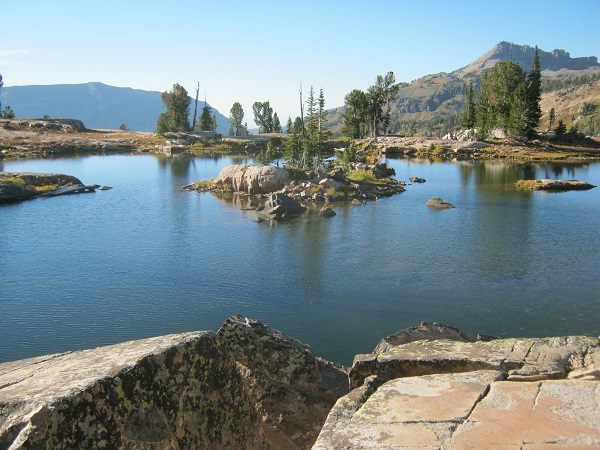
Back from the Tetons

A few weeks ago I went on my annual hiking trip with my friends. We did the Teton Crest Trail, which winds around behind the iconic view of the Tetons above Jackson Hole that you always see.

It's a fantastic trail, and had the great advantage of being accessible by an aerial tram, usually serving skiers, which let us skip 4000 feet of what sounded like a strenuous but uninteresting climb up Granite Canyon.

I look forward to our hiking trip all year, and then look back at it with fondness, so, in a real sense, it is part of the structure of my life. I've had to miss it a couple of times, and still regret what I missed those years. I mean, how many trails can I manage to hike in what is left of my life?

Enough of that. We're already discussing what we're going to do next year. Meanwhile, here are just a couple of pictures of 2015:

Beautiful sunny weather, except for that last day, as you can see. But still beautiful.

Learning the wrong lesson: the Battle of Lissa and the resurgence of the naval ram

Last week's discussion of how to win WWI got me to thinking about how you draw lessons from history--more specifically, in this case, military history. You won a battle. Or you lost one. Why? What about your approach, your weapons, your generalship, was the decisive factor? Deciding this is much harder than historical fiction makes it sound, because the easiest (and laziest) way to make a historical character seem smart is to have them anticipate the future and be able to easily distinguish between the necessary and the contingent in a way that was completely impossible for any real person living in the confusing flow of actual events.

This, incidentally, is how doctors in historical fiction work. They anticipate the past couple of centuries of data analysis, experiment, and many false paths just by being smart and observant, so they never ruthlessly bleed people, blister their heads, or make them throw up, and then blame them for not getting better, unlike real historical doctors. I've never read a credible doctor in a historical or fantasy novel. Stephen Maturin in the Patrick O'Brian books comes closest, I guess, but even he has a too-high success rate.

The entertaining Great Courses class The Decisive Battles of World History, by Professor Gregory Aldrete, starts out with a description of the 1866 Battle of Lissa, in the Third Italian War of Independence. Don't worry if you've never heard of either the battle or the war--I never had either.

Lissa was a sea battle between Italians and Austrians off the coast of Croatia, and involved both ironclads and wooden sailing ships. The Austrians won, but since they lost the significant Battle of Königgrätz (also called Sadowa) to Prussia the next month, this particular victory had little effect (Aldrete uses it to lead off a discussion of what actually makes for a decisive battle). But during the Battle of Lissa itself, several ramming attacks helped decide the issue.

As a result of this, all European navies for the next 40 years put rams on their battleships, as if they were giant, steam-powered triremes (perhaps the example of ancient Greek naval warfare encouraged over-educated procurement officers to make this odd decision), even though they would prove to be utterly useless in an era of long-range gunnery.

Here are a couple of examples.  First, the American ship USS Alarm, 1874:

Then there is the HMS Polyphemus, 1882:

It's not just the name: the Polyphemus really did look like a trireme:


During the US Civil War, in 1862, the USS Cumberland was rammed and sunk by the CSS Virginia during the Battle of Hampton Roads, but Europeans tended to neglect the instructive experience of those crude Americans during their internecine squabble. It was Lissa that was influential.

In retrospect this seems completely crazy. But there were real reasons for making this choice. Naval guns were still weak and inaccurate, while armor had already become quite good. So shells tended to be ineffective in sinking opposing vessels. The ram promised a useful form of offense that would even the odds. They never actually ended up being used in battle. And naval guns quickly became more accurate and more powerful.

But these rams were not only useless.  According to this Center for International Maritime Security article, they were actively dangerous, because ships on the same side tended to sink each other on maneuvers, or in bad weather. It was running with scissors, naval style. You ended up poking your eye out.

It is incredibly difficult to figure out what is the important fact from a chaotic, fast-paced, and contingent set of experiences. And don't ignore the influence of trends, conventional wisdom, and fear of being wrong or ridiculous.The people who make influential decisions are always embedded in a complex and interactive social matrix. If they aren't, no matter how smart they are, they have no influence over events.

It would be incredibly hard to write a novel where you show a really smart person being repeatedly and completely wrong--and still smart. But that is what history is all about, how truly hard real lessons are to learn.

None of the many ship models I made in my youth was an ironclad with a ram. But now I'd like to find one.

And maybe I can work one into a story somehow.

The fictional and the real: WWI and narrative

Recently, I've listened to Dan Carlin's fine (if a bit overlong) podcast series on the Great War, Blueprint for Armageddon (in six parts, and currently free on his site, Hardcore History.  Well worth your time), and read the book Carlin acknowledges as a significant source, Peter Hart's The Great War, a Combat History of the First World War, which I also recommend, with this caveat: the maps are terrible. You'll need something like the resource I used, Arthur Banks's A Military Atlas of the First World War to have some idea of what is going on.

Together, those sources gave me much better appreciation for the military challenges of winning the war on the Western Front, particularly from the Allied side. In essence: you couldn't. The French and British got better and better at attacking as the war progressed, learning how to use moving barrages, how to concentrate their forces, how do combined operations with aircraft and tanks. All that ever got them was a few miles and a lot of dead men. Even at their best and most organized, each offensive would reach its initial objectives and then, while they regrouped for the next round, the Germans would also reorganize and present another defensive line. Not a single one of these offensives achieved any larger objective.

And many of them were not at all well-organized.  Over and over, Hart tells how either the British or French would be hard-pressed, about to collapse, and desperately request their allies to launch an offensive to take some of the pressure off.  Even though even well-planned and well-resourced offensives failed, the commanders would scramble to comply, essentially slaughtering thousands of men to maintain a feeling of alliance. Nothing ever succeeded.

So that is why the whole four years feels like one endless static nightmare, except in the beginning, at the Battle of the Frontiers, and at the end, when moving armies meant that the casualties were way higher that they were even in brutal assaults on trenches. Carlin refuses to detail much of 1915, because every horrible battle was exactly like every other horrible battle, and no one yet had much of a clue how to manage things.

So no wonder that people with a sense of narrative, like Churchill and Lloyd-George, became what were called Easterners, trying to find some way they could attack without facing the iron wall of the German army in the West. The results were just as terrible: Gallipoli and Salonika (where, after getting all bent out of shape about Germany's violation of Belgian neutrality, the British blithely violated Greek neutrality in pursuit of their own goals). Even the successful Middle East campaigns, featuring the charismatic Lawrence of Arabia, were just sideshows that drew resources from the main fight. Not one of those operations were worth the effort.

You could tell bad commanders by the fact that they killed way more of their own troops, but there was no way to be a truly good commander. No genius could come up with some spectacular tactic. New weapons systems, like tanks, would work well at first and then break down. No propaganda could affect the enemy's will to resist.

None of us would ever come up with something like this as the basis of an SF or fantasy novel. There we like people who affect things, make things happen, and can anticipate the actions of the enemy. None of that on the Western Front. The best thing would have been for everyone involved to negotiate some kind of status quo ante treaty after the First Battle of Ypres in November 1914. After all, by the end of 1914, the French alone had already lost something like 300,000 dead, an unbelievable 27,000 on just one day, August 22.

Of course, everyone still believed there was a story to tell, one with some kind of narrative. It's startling to think how long they would have to wait for the end of the story.

Dystopian slipstream pornography!

This is no place to learn about the recent Hugo award kerfuffle (Sad Puppies, oppressive gynocrats, etc.).  There are plenty of thoughtful people writing about it, and I won't point you to any one.

But, I just need to point out a comment on George R. R. Martin's post, Me and the Hugos, from Lou Antonelli:

Whether there is an organized blacklist or not, the fact remains literary science fiction has become a boring repetition of dystopian slipstream pornography. (emphasis added)

I believe this is a movement. It needs a manifesto and an anthology, at the very least. I feel like I have regained my faith in speculative literature. Who's with me?

(HT to my friend, writer Olivia Hall Fowler, who pointed this term out to me)

Best sentences I read today, post-mortem edition

From a great article, DeathHacks, in the online magazine Medium:

You should know that for unattended deaths the cops will show up and remove any prescription drugs stronger than Advil and they will not return them. If you are a newly-bereaved family member looking for something in the medicine cabinet to take the edge off, you’ll be out of luck.

It's of a techie woman dealing with the elaborately programmed house left behind by her even techier father.

Aside from the advice that all of us should have

a will; durable power of attorney; healthcare proxy; and a way for your loved ones to access (or not) your things, both material and digital

She tells an interesting detective story, of trying to reverse hack her father's oddball programs.

I suspect SF editors will be seeing a bunch of stories based on this article in the next couple of months. It has a lot to offer: mysterious motivations, interesting technology, and the relationship between a daughter and her now-dead father. There are a number of ways to take it, from suspenseful to emotionally revelatory. I may try it myself, but by the time I get to it, editors will be heartily sick of this unasked-for subgenre of competitive hacking between generations and across the abyss of death.


Word for the day: petrichor

Most writers know way more different words than they use, though there are the occasional outliers who use way more words than they know.

That's because writers like readers, and many readers do complain when a writer uses a word they don't already know, as if any of us already knows all the words we will ever know. Has this changed with online dictionaries easily linked to the actual text being read? A Kindle lets you look up a word instantly. I would be interested to hear if anyone has done a study of whether people are now more willing to attack a "difficult" text, knowing they won't actually have to get up and go open a dictionary when they hit an unfamiliar word.

Allusion assistance can't be far behind.

This is all by way of my getting to a cool word I learned today (via a story about rain on The Dish): petrichor, the earthy smell of rain when it first falls on dry soil.  The name was made up in 1964 by two Australian researchers, and comes from the Greek words for stone (as in "you are Petrus, the rock on which I will build my church") and ichor, the word for the fluid in the circulatory systems of the Greek gods, which got used by H. P. Lovecraft and people imitating him for the circulatory fluids of aliens and other creepy creatures.

It's not a very mellifluous word for such a sensuous, specific concept. If I do use it, no doubt tying it to a specific memory a character has, I will probably define it, just because this really is one of those "there's a word for that?" words.

Why "The Moldau"?

I usually listen to my local classical music station, WCRB, while I work. Sometimes I listen to All Classical Portland, which I started listening to because I start writing really early in the morning, and the all-night shows tend to have less chatter on them.

Both of these stations have a number of pieces they play over and over again, and one of these is the section of Smetana's Ma Vlast called The Moldau.

I remember when I first heard that piece, as a teenager. It came on some record of classical selections, I don't remember what, and I loved it. It's a great piece of program music, traveling down a river from its springs to its greatest majesty.

I still love it--and own the complete Ma Vlast. But it seems like this piece in particular gets way too much airplay.

European concert music, Baroque to Early Modern, is my music, the music I grew up on, and the music I still return to, both for stimulation and recentering. I do worry about wearing it out. But the unification of my thoughts with the music really enables me to get my work done. At my age, that's nothing I would give up on easily.

I have recently been changing location, from my office to the living room, where I take notes and think in total silence. It's an odd feeling, like I should be able to hear the rattle of the little marble of my mind rolling around inside my skull. Sometimes old and familiar habits need to be disrupted simply because they are old and familiar, and thus rote. I'll see if I get something out of this.

I may well miss a few playings of The Moldau, which would be OK.

Update, 12/17/14, 10:43 a.m.:  I just tuned to All Classical Portland, and there it is again! Those damn peasants are dancing (one of the sections of the piece, if you are unfamiliar). Oh, well, it always sounds like fun to me.  Happy peasants. How we envy them, and their folk dances.