Jane Austen and Film Noir

I recently read Jane Austen's Emma for a book group I belong to. A few days later, I watched an interesting minor noir, Too Late for Tears. And I got to thinking about the connections between Jane Austen and film noir.

Short answer for the impatient: film noir is what happens when a Jane Austen heroine discovers that the man she's married has way less money than she thought.

In Too Late for Tears, from 1949, Jane and Alan Palmer are a couple who unexpectedly end up with a bag of obviously illegally obtained cash. Jane sees the windfall as a way of escaping their life of installment payments, Alan isn't so sure. That's not a good stance for Alan. Jane maneuvers around everyone who threatens her hold on the cash, and is eventually brought low only by a narrative contrivance.

Emma is actually not a good example for my thesis, since Emma Woodhouse actually has a fair amount of money of her own. But Jane Austen heroines are compelled to make sure their passions match their interests, and fall in love with men able to support them.

Sometime later, I also watched the biopic Miss Austen Regrets, which deals with a slightly fictionalized version of Austen's later years, when she has to face the consequences of choices she made earlier in her life, and struggle to support her family through her writing. Olivia Williams is great as Jane Austen, BTW.

Immediately postwar America was on the verge of a boom, but it must not have felt that way after a decade of Depression and half a decade of war. Early 19th century Britain's Industrial Revolution had not yet had significant economic effects, and it was still a static economy. In such economies, if one person has more, someone else has to have less. The pie isn't growing. There is only so much productive land. Thus, it's easy to lose out, and live the entire rest of your life in penury. There are few second chances, particularly for women.

The women of noir also feel that the pie isn't getting any bigger. As with Austen women, their physical attractiveness is their only real asset in the search for secure wealth, while their cleverness is the hidden asset that allows them to leverage that attractiveness to get what they need to survive.

Too Late for Tears actually stimulated a lot of interesting thoughts. Lizabeth Scott as Jane is an oddly compelling high-cheekboned ice queen, though handicapped by a stiffly waved do almost as ridiculous as the one imposed on Barbara Stanwyck in Double Indemnity five years earlier. The trusting and slow-witted Alan Palmer is played by Arthur Kennedy, who would have much more fun as the roguish and sly Emerson Cole in the superb Anthony Mann/Jimmy Stewart Western Bend of the River, a few years later.

And the somewhat pathetic baddy, blackmailer Danny Fuller, is played by Dan Duryea, specialist at the half sniveling/half snarling villain. He is a few notches below his best here, and handicapped by a big suit that can't hide that he's a skinny little weasel. He would do much better as Waco Johnny Dean in the Mann/Stewart Winchester 73, the next year. Some people think of those Mann Westerns as Western Noir, which would explain the commonality of actors, but that's not the genre-slip I'm concerned about here. Worth thinking about, though.

If you add some Emerson Cole to the somewhat dull-witted Alan, more Waco to Danny, and make Jane, well, Jane, I think you'd really have something. The once-flirtatious witty repartee has turned deadly, the home economics are grim, the wife is ready to use her quick wits to figure a way out of this situation. But Darcy...I mean, Allan, has a few more tricks up his sleeve than he was allowed to use in the current version.

A static economy leads to existential despair. A static economy that was once a growing economy leads to rage and murder. We'll see if the current impasse in our political system returns us to noir as a way of life, rather than just a style.

Me and the government shutdown

I am a victim of the government shutdown, in a "First World Problem" kind of way:  if all had gone as planned, I would be hiking down below the North Rim of Grand Canyon today.  Instead, I am in my basement, typing this.

My annual hiking trip with my friends is something I look forward to all year.  And we had tried several times to get space at the limited North Rim campsites in order to do a good loop hike. We did the trial-by-fax application process (OK, my friend Paul did, by going into his office on a Saturday and sitting by the fax machine) three months ago. We finally got our spots.

Paul actually drove up there from Santa Fe to meet us, and found himself virtually alone in Kanab, Utah, as everyone waiting for a rafting trip, a hike, or anything else to do with the federal lands up there pulled out and home.  Now he should be home as well.

I will deal with my political reaction to this shutdown elsewhere. All I can say is that I hope I don't run into Rep. Randy Neugebauer on the trail anytime soon.

Picking up old projects

Now that I have turned my novel in to my agent, I'm turning back to some things I was working on before I really dove into the revision.

There are a lot of unfinished stories and other projects littering my mental universe. I have notes in various formats: an old composition notebook, bundles of notes on yellow 6x9 pads, bundles of note cards, crumpled sheets quickly scribbled on at work or while doing something else, emails to myself, even text generated by Dragon Naturally Speaking when I was unable to see after my eye operation...not each of these is done by a different personality, but it is still disturbing to come across having forgotten the original moment of thought.

I also have unfinished drafts, sometimes multiple ones.  Sometimes I have forgotten why I restarted, or what I was after with the new approach.

The one advantage is that I have completely forgotten how much work is invested in each piece, and so can look at them a bit dispassionately, seeing only how much work remains to get each one to submittable quality--or abandon it as not worth further investment.

But, jeez, there are a lot of them. My life has been in disorder for longer than I consciously realized, and big changes have been going on that I only recently really gotten to grips with. And these changes are far from complete.

I hope I have some time this weekend to bring order to this obsessive mare's nest.  I leave for my annual hike next week, and when I come back from that, don't want to return to something that looks like case files from a competency hearing....

On losing a Kindle

I never thought I would like an e-reader. Actually, I'm still not sure I like it, but I sure need it.

As I mentioned, I lost my Kindle on a business trip to Toronto  Everyone I contacted was very helpful, including the Toronto Police Department, but it has not turned up.  Next week I am flying to Las Vegas and then driving up past Jacob's Lake to do a one-week hike down the North Rim of the Grand Canyon.

I like to read in the evening when I hike.  And, at this time of year, there is not only evening but a lot of night that I can't really sleep through.  But books are heavy.  Sometimes I've hauled pretty heavy books, which is great for when I'm not moving, but made moving painful and slow. Pretty dumb, in retrospect.

A Kindle, or similar e-reader, is a great solution. Doesn't weigh much, and carries a lot, including maps and trail information.  I often PDF notes and other information to put on it.

My Kindle stores a lot of classic literature, obtained for free or for really cheap.  And, believe it or not, sometimes I read it.  I've done Barchester Towers, which I keep meaning to blog about. Actually, there's a lot I keep meaning to blog about, but I usually only blog when I'm avoiding writing...like right now.

It also has a distressing amount of self-help literature on it, the main thing I am missing right now. I don't like getting too intimate here, but there have been several big problems in my life recently and among the vast mass of self-help books are some that are...well, extremely helpful. Call them "moral philosophy" if it makes you feel better about them. Most of the great books of philosopy from the Roman period, whether Epicurean, Stoic, Skeptic, or Cynic are really self-help books.

A Kindle is also perfect for insomnia. It won't wake anyone else up, and the light level is really low, so I'm convinced it doesn't reset my internal clock. Because of those stresses, I wake up a lot in the middle of the night.

So I need to get a new one, and, as it happens, a new model of Paperwhite is ready just before I go. So I ordered it.  And I thought these things were supposed to save you money.

Forced to proofread

I was on a business trip this week. I was doing something both interesting and stressful:  videoing analysts at the company I provide marketing for.  I had to learn how to set up lighting and sound, select and buy equipment, and then learn to use all of it. I think it all came out well.

But somewhere along the way I lost my Kindle.  I'll try to track it down today.  I don't favor the Kindle for regular reading, but when traveling or camping, it's great, given how much it can carry.  So I had no other reading material with me, and only discovered the loss in the departure lounge.

To entertain myself I was forced to do something I've been putting off: proofreading the scanned files from my backlist, starting with Carve the Sky, preparatory to turning them into ebooks for a new generation of readers.

I got maybe 15% of the way by the end of the flight.  This is going to take awhile.  But it is essential.  I'm resisting the urge to rewrite anything, though I do fix an occasional word choice I no longer agree with.

But, you know what?  The book's not bad.  I try to write things I would like to read, and Carve certainly qualifies.  Maybe it can find a new life as pixels, since ink on paper (its natural medium) just didn't cut it. The question is whether I can give the task the time it really needs, given that I want to keep writing new stuff too.


Book Groups, and the Literary Blind Date

Years ago I belonged to a book group. It was a group of biology researchers of various kinds at Harvard, as well as friends and hangers on, who liked taking a break from lab work to discuss literature. It went on for a few years, and I had a great time, made friends, and read some works I would not have found otherwise.

I haven't done anything like that since. Recently, however, I've started checking out various Meetup groups in my area, including a couple of book groups.  Last night I attended one that discussed Nabokov's fantasia on his early life, Speak, Memory.

A first session with a new book group is very much like a blind date. Will they like me? Will I like them? Will we have anything to talk about?

In the event, I had a great time. Smart people, great discussion, and we got to meet outside at Radcliffe Yard until it got too dark to see each other, and it got cold, and a guard showed up to tell us we weren't supposed to be where we were.

I'm also trying out another book group, one that meets in bars associated with the topic of the book being read. I liked the first meeting of that one too.

Reading books for book groups risks being yet another assignment in a life overfull of them, and another way of getting behind on other reading, but meeting interesting new people makes it worth it. It got done writing my book at the same time as a number of other things are changing in my life. It's time for a change of mental scenery.


Gestation speed

The germ of the idea for Timeslip (or whatever--as I've mentioned, I'm trying to come up with a better title) came to me while I was a participant at the Rio Hondo workshop in the hills above Taos, NM in May of 2010.  Several other people had submitted sections of YA novels, and I thought "hey, maybe I can do that!"

I got up early one morning and drove off to take a hike by myself.  As I walked, the character and basic structure of the book came to me.  By the time I ran into too much snow to keep going, I had enough to get me started: my main character Doug, his father, and the device his father has invented to get into other worlds with other histories, the device that brings someone from one of those other worlds into ours, and gets Dad kidnapped.

Later that year, my family and I spent a week in the Adirondacks. Every morning I got up early and did experiments with the book. That's the way I get through the initial planning of a novel.  I pick some possibility and examine its implications, and its downstream consequences. I wouldn't say that's an efficient way to do it, but I don't have the gift of distinguishing fruitful possibilities from sterile ones. I have to take each one out for a fairly extensive test drive. I sat out on the porch, feeling the light grow over Long Lake while the family slept, and scribbled in what is now the first of a thick series of notebooks lined up near the desk where I write this.

The first draft went fairly quickly, by my standards, and I had it done by September of 2011.  Why, then, did I only manage to turn the thing in in September 2013?

Partly, it's because I'm an idiot. Or, to put in a way that is both nicer and more accurate, I have an "uneven cognitive profile" -- #6 in this quick essay on procrastination, by an online advice-giver, Dr. Alice Boyes, whom I've really gotten useful advice from. In many situations, my cognitive strengths allow me to skip over the things I don't do well.  But a novel, or a really busy job (as I have right now), sometimes exposes very real blindspots that I need deal with. Let's call that my UCP problem. Finding a way to detect the blindspots before they cause real problems is the main task of my self-analysis.

And partly it is that fact that I do work full time, at a job that requires a lot from me, and am my family's main financial support.  But that might account for one year of the delay, not two.

Despite my best "fruitful alternative" planning, I often end up in a narrative dead end.  I'm not particularly adept at working out complex plots with lots of competing parties, and yet, those are the plots I tend to favor.  Why not an entertaining picaresque, where one thing happens after another, and aside from a few coincidental meetings with characters from earlier in the narrative, there is no plot to speak of? I dunno.  The inspirations for those just don't seem to come to me.

So I ended up stuck several times, and had to work my way back out. I rewrote it, gave it to the Cambridge SF Workshop a year ago, and they gave me some useful advice.  Then, as often happens, I had too much to think about and fumbled and procrastinated. Was that wasted time, or useful gestation? Some of both. I did get a much stronger last third as a result.  Still shouldn't have taken so long.

On the topic of novel revision, the best advice I've found anywhere comes from writer Holly Lisle: her blog post How to Revise a Novel. Her ruthless scene-by-scene analysis really brings every problem out into the open. Now that I have incorporated her advice into my practice, I'm hoping it will percolate back into the actual scene construction, making the book "revision ready" in the first draft.

As I said, I'm hoping.

But, you know what?  I like this book a lot. I read every word while proofreading and line-editing this last time, and actually felt good about it. That's rare. Writing a younger protagonist, and striving for simpler language, forced me away from my love of imagery, background information, and complex language and into a sparer, more dramatic style.  I'm not giving any of those up, by the way. But I hope that when I revisit them in another book, I can use them because I want to, not because I need to in order to make up for other deficiencies.

It's Sunday morning.  I want to write a few stories before I start my next book. So, I will press "publish", get another cup of coffee, and get to it.

Done. Now what's the title?

Last night I wrote that I was almost done with editing my latest novel.  Now I actually am done.

I've been talking about this one for a while.  It's a YA novel about a teenager whose father invents a way to cut through to alternate histories--and then someone comes in through from one of these alternate worlds, kidnaps Dad, and disappears. I just reread every word of the thing without cringing.  I hope that's a good sign.

The problem now is the title.  It's working title all the way along has been Timeslip. But, as my writing workshop pointed out, it's misleading. It's not about time, its about worlds.  My friend Steve Popkes has pushed strongly for Crossworld. There are merits to the suggestion, but there's an evangelical tinge to the term, as you can see from this organization.

I like getting "World" in there. But putting that word first, as in Worldslip, crams too many consonants together. The same problem dogs my actual favorite alternative Worldswap. That's probably why this simple combo has never been used as a book title, as far as I can tell.  Crossing Worlds has been used once, but for a historical novel, not an alternate world adventure, so that's a possibility.

I often get stuck at this point. I want a title that lets the reader know at least a bit about the book.  IF anyone has any votes or suggestions, I'd be glad to hear them.

Teetering on the brink

For the past few months, I have been revising my next novel, a YA alternate history adventure.  At least the character is adolescent, and the language is simple, but I'm not sure it fits the current model of bonding-against-dystopia YA fiction.

And for the past couple of weeks, I've been doing a detailed proof and clean, and resisting the urge to do any deeper editing. As they say, no book is ever finished, just abandoned, and sweet noises this one makes, I'm leaving it on someone's doorstep soon.

And I'm a day or two from submittable version. It's been a long haul, my job has been stressful, and I'm in a frazzle.  What will I do when it's done? I'm not really sure.

Genre and non-neurotypicality

Last week I discussed genre, as, in part, a contract between writer and reader, reader presenting an itch, writer agreeing the scratch it. Writers who then refuse to scratch, but instead provide something they claim is vastly better, often fail dramatically.

Believe me, the sales figures for Brain Thief, a humorous cultural critique disguised as a science fiction novel, demonstrate what happens when readers expect one thing and get something else. Remember, if you click that link, you have been warned.

But, taking a step back, think about readers. Think about fans. Think about science fiction fans. A curve showing SF fan personalities, in terms of rationality, sociableness, intelligence, ability to read inner mental states from outwards signs of expression and posture, whatever you want, will show a skew in a certain direction. We are not as others are.

Well, our mean is not as other means are, at least.  Clearly there's a huge overlap, now matter how you try to sort. But that's enough of a skew to establish an audience that tends to have a certain itch. Science fiction, the genre, evolved, as a set of conventions, tropes, and customer types that works to scratch it. And those SF fans talk to each other, form communities, write back and forth, and define their itches in ever more detail.

I doubt any other genre has a fan base that skews this far from the mean.  Of all genres, SF is the most genre-y. Violate its dictates at your peril.

As I said, I know whereof I speak.

Genre, again

As usual, when I was at Readercon a few weeks ago, there were panels on genre, and, again as usual, the highly literary panel participants viewed genre with suspicion and disdain, wondering at how restrictive genre definitions are.

Just as you can't analyze rising healthcare costs without looking at jobs, you can't analyze genre without looking at readers.  But if you sit in on these panels, you'll invariably hear a lot of discussion (don't get me wrong: intelligent and thoughtful discussion) about what the writer does, how the writer achieves effects, what the writer wants to convey. The reader, both individually and en masse, gets short shrift (BTW, I just looked up this term I've been using much of my life, and discover it refers to a shortened form of last rites, or shriving, used at busy and time-crunched Elizabethan executions: "Chop chop, buddy, there's people waiting." So not only are we executing our readers, we're doing it on the cheap.)

But I think I'm getting distracted. This is the genre of blogpost, which rewards a good subject line and a tightly focused, pithy couple of paragraphcs on a specificy topic. Genre will keep me focused. In genre there is strength.

OK. Too late for pithy. What is genre? I presume there a million definitions or descriptions.  There are a few ways of looking at it, some of which I might explore at some point.  Let me just list one here.

Genre is a contract between a reader and a writer. The reader agrees to give up some portion of a limited lifespan in return for some entertainment of a certain defined type from the writer. Genre defines the kind of entertainment. The writer violates this contract only at peril, and can succeed only by giving way more than the reader expected, while simultaneously scratching the same itch the original genre was going to scratch.  This is key to successful genre violation by a clever writer: it has to satisfy the original need, only in a different and unexpected way. 

Say the reader sits down to read a good mystery, one that reveals all sorts of things about a specific milieu the reader is unfamiliar with, puts characters under stress so that they reveal things they would rather keep hidden, and, at the end, unites all sorts of disparate and seemingly contradictory observations with a single explanation. Instead, the writer shows how all the events were caused by a combat between angels and demons.

I don't care if the writer has provided Paradise Lost. The contract has been grossly violated. Even if the reader believes in angels and demons, this isn't why they are here. That isn't why money was transfered. That isn't why time was set aside to be spent. And the original itch, the tension and resolution of a mystery, has not been scratched.

So that's why when Milton sits on a panel and says "Yeah, I called it The Chancel Mystery, but I gave those ungrateful wretches Paradise Lost, for heaven's sake. Why are they bitching?"

Genre allows us to determine which itch is being scratched. And, sure, there is an itch for "deeply perceptive literature". But even people who like deeply perceptive literature usually also like a brisk well-written mystery, or a romance, or a space opera too, depending on their mood, the number of unstressed brain cells available, and whether they're at the beach or in their best reading chair.

 So, sure, genre can be a straitjacket to a writer longing for some flexibility. And these distinctions can be determined by marketing, rather than inner reader needs. Still, before writers get all bent out of shape about genres, they need to see whether they've been holding up their end of the contract.

Me and Readercon

A couple of months ago, my wife Mary scheduled me for a family reunion in Indiana--the same weekend as Readercon. I notified Readercon that I could not attend.

Then a family health problem cancelled the reunion.  So I will be at Readercon after all, but as a paying guest, not a program participant.  If you want to find me, I will have no cool ribbons or anything and will have no fun quote for Meet the Prose on Friday night.

I hope to see you there.

The plight of the secret teacher's pet

SF has a lot of tropes, that is, standard plot devices, character types, or backgrounds that are used to move stories forward.

A genre is itself just a trope writ large, so it should come as no surprise to find that SF is completely trope-ridden. It's not a bug, its an exoskeletal alien.

I've been trying to read more SF, particularly in its short forms, than I usually do. The result is a kind of queasy feeling of getting overstuffed with tropes.

One I've encountered a couple of times recently is what I call the "secret teacher's pet". You can read that as the pet of the secret teacher, or the teacher's pet who is a secret. It works either way, or, rather, both are true simultaneously.

This is how it works. The protagonist is in a school or other training situation. Since the vast majority of the readership is still in school, this is a background with some emotional heft. The protagonist is too smart, too mercurial, too virtuous, or too dedicated to fit into the normal training program. After various dramatic failures, protagonist is going to wash out and have to leave in disgrace.

Only, guess what? The protagonist's very failure to master the approved curriculum of the school is what marks him or her as someone appropriate for a higher level of training. The ugly duckling becomes a swan.The class clown becomes the teacher's pet.

To me there is something unsastisfying in the idea that the point is to appeal to a level of administration above the one you normally encounter. But appealing to the administration is still the point of the exercise. As in Gnostic sects of Late Antiquity, outer practices delude the untrained, and only initiates understand the inner truth. Gnostics were a lot more like cliques of high school mean girls than most people who idealize them as an alternative to Christianity are willing to admit.

The story gets extra points if the protagonist is young, and manages to get the crusty old instructor to throw her head back and laugh at the protagonist's impudence, just as the protagonist is sure he is going to be thrown out of school. Just getting her to laugh isn't enough. Head back, or no points. I'm a tough grader.

I suppose now that I've gone off on it, I'm going to have to write a story using this particular trope. That's a way of learning where it gets its power, and maybe putting a bit of a spin on it. But I'm not making any promises.


Do second weddings count?

As you might  know, I'm a big fan of the BBC radio show In Our Time, which I get as a podcast and listen to while running. The most recent show, on the invention of radio, contained a discussion about how little credit Marconi ever gave to anyone else, among other personality flaws, and included this exchange:

Simon Schaffer: This is a man whose best man at his wedding was Mussolini.

Elizabeth Bruton (quickly, seeking to set the record straight): Second wedding.


Panoramas and viewsheds at Gettysburg

Here, (via The Dish) an interesting interactive article by Anne Kelly Knowles, from The Smithsonian, showing what commanders could and couldn't see during crucial points during the Battle of Gettysburg. It's really fun, and well worth a look.

We're used to seeing God's-eye-views of battlefield diagrams which show everything, and also know how things worked out, so we get a skewed sense of what it was like then.

The article shows panoramas, which lets you scan across a generated image of what the battlefield actually looked like from a commander's point of view. Of course, it is devoid of concealing smoke and mist, as well as time pressure, noise of detonations, and constant influx of frantic written and spoken messages.

In addition, you can examine viewsheds, which show the map with blind areas from the commander's point of view. You can see how at crucial points, Lee had no way to see significant parts of the Union force. Of course, he did not need to rely solely on his own eyesight: he got those aforementioned frantic messages.

Still, walking through the battle using this tool gives you a real sense of the blindness that was inherent to the technological level at which any of these battles were fought. You just couldn't see anything. How did the best commanders integrate all the information thay had into a simulation of what they concluded was out there? It's an interesting form of mental processing, and clearly only a few of them were really good at it.

The graph that shows why healthcare costs aren't coming down

Via Derek Thompson of the Atlantic:

Employment Growth in Healthcare Industries

I've said it before, and I'll say it again: unless you understand healthcare provision as a jobs engine, you don't understand what's driving it. Yes, look at ridiculous billing practices, unnecessary procedures, gold-plated equipment purchases, etc. All those are important. But not as important as jobs.

Thompson says non-healthcare job growth over the past 10 years has been....0.2 percent per year.  Yow! Most of my employment over the past decade has been healthcare-related, and now I can see why.

And many of these jobs, whether physician assistant, front-desk staff, coding, home health aide, are a route up for immigrants and the people from non-professional backgrounds. They've replaced manufacturing jobs as the way to make it.

So, when you want to cut healthcare costs, take a look at the interests you'll be challenging, and realize that your job is even harder than you thought.

Of course, healthcare-cost pundit is yet another growth profession in this expanding healthcare economy.

Waterworks

Thanks to a suggestion from reader John Redford, this weekend I took a bike ride over to the Metropolitan Waterworks Museum in Chestnut Hill, Boston, for a look at some heroic public works.

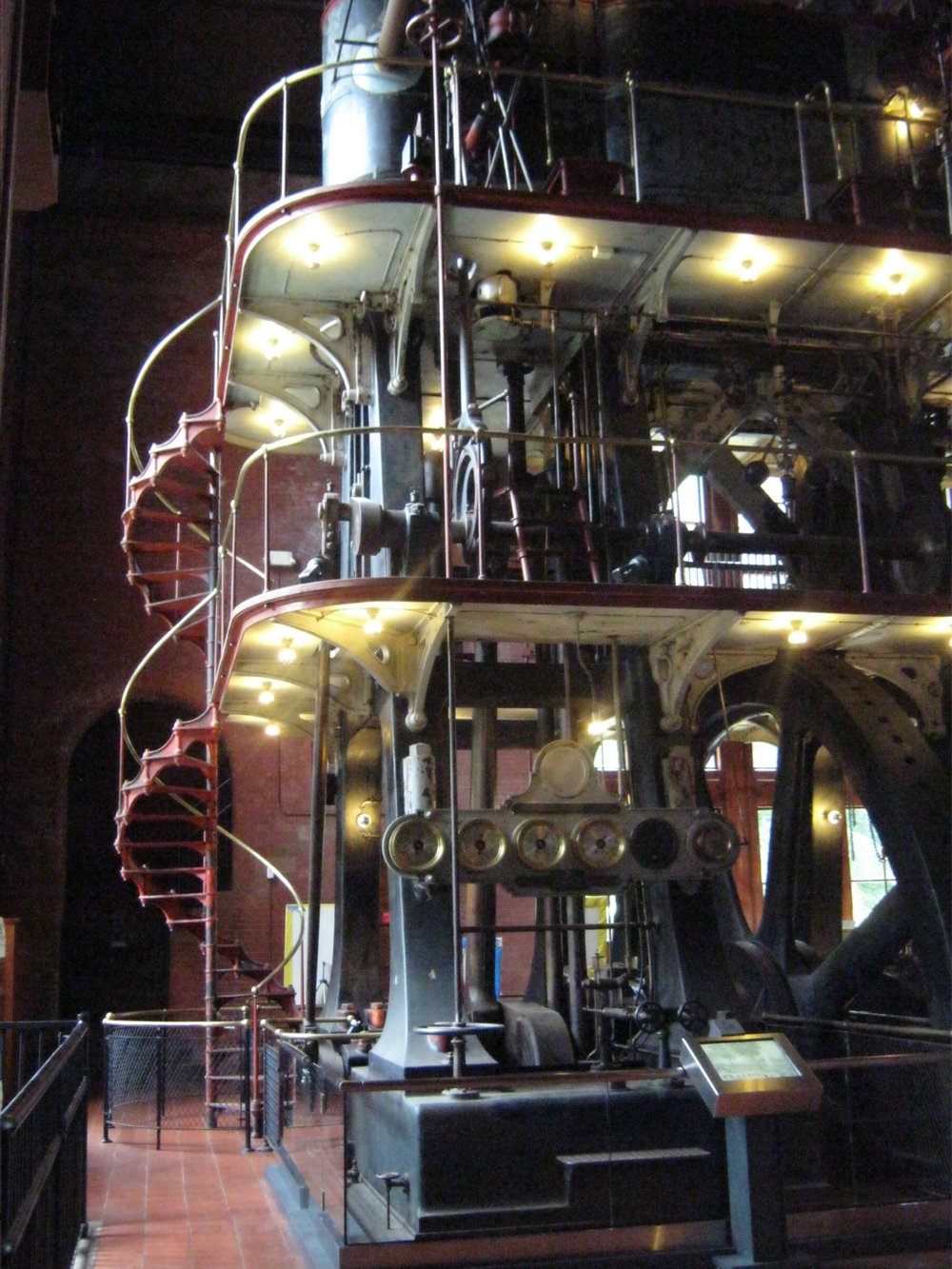
If you like Richardsonian Romanesque public buildings containing some behemoth steam engines, all spruced up and ready to go, this is the place for you.

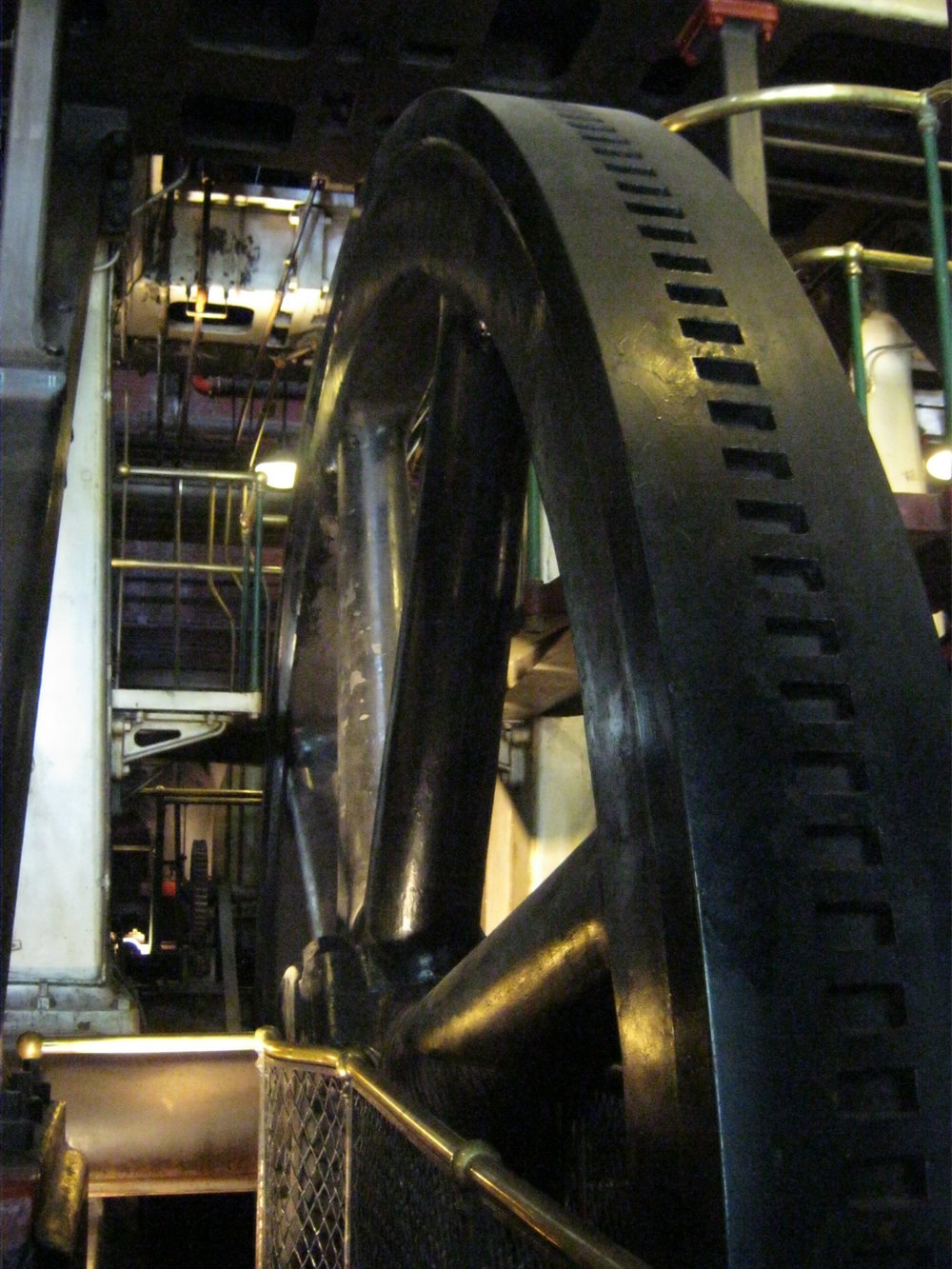
Quite the popular style, until suddenly it wasn'tBut it's what inside that makes this place great.  Three multistory steam engines, two of them triple expansion, which means they have three cylinders, each one larger than the previous one, since it works on the lower-pressure exhaust of the first. At the far end is the newest engine, the Allis:

This is just the bottom of the thing.Another viewDid people spend a lot of time protesting "Big Steam"? Yeah, they did.View from the balconyI went by myself--not a lot of people like hanging out in places like this. And I had it almost entirely to myself.  It also has some thoughtfully designed display screens with animated cutaway diagrams of the various engines. Great fun.  Thanks for the suggestion, John.

Buzzkill in the NY Times

Today's Science Times had two nannyish articles, in the category of "it's 'science' if it gives you evidence that makes you behave in a more socially useful way".

First was "Designated Drinkers" (I don't see it online). Apparently occasionally the "designated driver" in a group has a drink early in the evening.  A study showed that 65% of those identified as designated drivers had no alcohol in their blood, 17% had .02 to .049%, and 18% had .05 "or higher" (the article coyly refused to say how high, but did not indicate that anyone was actually over the legal limit). Legal limit is .08.  The study's author announced that designated driver campaigns were "ineffective".

There's a lot of impairment out there, from sleepiness to texting to OTC medication. Alcohol in small doses is also an impairment. According to this calculator, I would reach .02 by drinking two beers in a three hour period.  I know that "two beers" is the standard unit of theoretical consumption for anyone, no matter how much they actually drank.  I'm talking about an actual two beers. Three hours.

Second "science" story: "Turn Off or Leave Running?", a horror-filled story about the dangers of running a dishwasher or charging a cell phone overnight. It mentions a dishwasher-related death, presumably this one.

When the rules are so restrictive that you can't follow them, what use are they? If you can't charge your cell phone overnight, when do you do it? How much attention should you pay to your dishwasher?

I always thought my life was pretty mundane, but knowing the risks I run daily, I am feeling like more a thillseeker.