My Arisia, January 18-20, 2019

Arisia_2.jpeg

I’m going to be at Arisia, a Boston convention, over MLK weekend. Instead of the Westin Seaport, where it has been for a few years, it will be at the Boston Park Plaza

As usual, I’ll be doing a few chin-stroking panels. I like to make them entertaining, but if you lack the stamina to watch four SF writers expound on some topic of intense interest to them, do find me elsewhere (like the bar). Or, better yet, find me and take me to a bar.

But I will have opinions about things:

Embracing the Alien: Writing Believable ETs

Saturday January 19, 10 AM

I’ve been writing a lot of aliens recently, after not doing it for awhile. I hope someone has clever suggestions I can steal.

Fellow panelists:

Timothy Goyette mod
Ruthanna Emrys
James L. Cambias
Walter H. Hunt

Writing About a Future That's Already Here

Sunday January 20, 10 AM

Yeah, we don’t even understand the present, so how can we write about the future? Why does the future still have people sitting in a row talking about a topic?

Also starring:

Trisha J. Wooldridge mod
James Hailer
Debra Doyle
Alex Feinman

The Past in Present Tense: Escaping Flashbacks

Sunday, January 20, 2:30 PM

I remember the transformative horror of the last time I was on a flashback panel…..

Unindicted co-conspirators:

Gillian Daniels mod
Debra Doyle
Leigh Perry
Amy J. Murphy

Hope to see you there. And if you are a co-panelist who has ended here because you were checking on who else in the world was talking about you, hope to see you there as well.

Oh, and happy new year 2019! Let’s see if we manage to live through this one.

Doing the Locomotion: Saratoga Spring and New York City

A few more Shorpy photographs of people walking, these focused a bit more on male style.

Previous locomotion entry.

Dress like you mean it

I do tend to notice men's dress, and here are a couple of good examples.

The end of the Nineteenth Century was right about now

The end of the Nineteenth Century was right about now

The coolest man in town

The coolest man in town

Saratoga Springs is a resort town, known for its horse racing. Here is everyone strolling in the shade of the elms, in 1915.

I’d love a look at the headlines

I’d love a look at the headlines

This couple is quite elegant, but I think the male far outshines his mate. Everything about him is sharp.

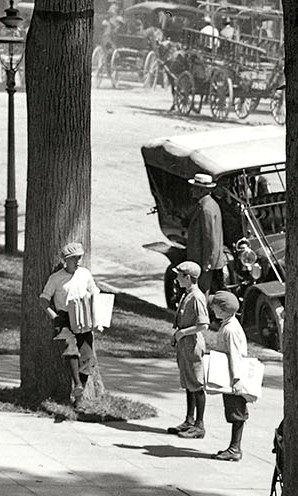
Meanwhile, right behind them: newsies! They really did dress like that. The more sophisticated older one is leaning casually against a tree, leg up, while the younger ones try to impress him with their street smarts.

 
Everyone has somewhere to be

Everyone has somewhere to be

Not just the clothes, but how you wear them

Not just the clothes, but how you wear them

Finally, the heart of purposeful walking, New York City. Here is a picture of the intersection of Seventh Avenue and West 125th, in 1938. Again, a lot of people, but I love this other gracious gentleman. Both he and the boulevardier in Saratoga Springs show that it's not just the clothes, but the way that you wear them. And, really, a hat helps, even though that is no longer permissible, and just makes you look like you're losing your hair.

 
Where is she going tonight?

Where is she going tonight?

But I also always like this cheerful lady right behind him. I wish I knew her.

I wish I knew them all, and it is a bit chilling, sometimes, to realize that they are all long dead.

Do you look at pictures of the past?

What kind of thing do you look for when you do? I also look at machinery, architecture, and trains.

The Return of Accents

No sooner had my written my post on English accents in a performance of Tom Stoppard's Arcadia than I went to a play here in Cambridge, called Barber Shop Chronicles, by Inua Ellams, a relatively young Nigerian-born British writer and performer.

One of the three angles of view

One of the three angles of view

It's fun, with scenes in a variety of barber shops across Africa, with one in London where emigre Africans hang out. The actors are all black men, have great voices, and know how to move, and even how to sit in an interesting way. It's tremendous fun.

And they have accents of their place of origin, some stronger than others. S, one of my long-time theater companions said she had to retune her ear, the same way she does with Shakespeare, before it made sense to her.

In this case, the accents are essential, not accidental. These are specific people, each from a specific place, and their voices show it.

One charming bit of business was that each man, when the haircut was done, got three views of the result. The barber had a decent size mirror that he would hold first to show a left view, then behind so the client could look in the big mirror (us, the audience), and then a right view. Each client examined himself carefully before giving approval. I usually just glance in the mirror, see that my haircut looks as it always does, and that's it. I'm clearly not taking this seriously enough.

They argue politics, talk about women, bitch about white people, and discuss sports, because the same soccer match is on in every barber shop for most of the first hour of the play. There is a bit of a plot, a personal conflict among the family running the London barber shop, but it's not that relevant, and I could have done without it. Interestingly, there weren't any pairs of men who were close personal friends. Men did like each other, but boastful camaraderie was as close as they got to friendship. I don't think anyone would write a play about women in beauty salons where there were no intimate friends.

It's two hours, without intermission, and the time zipped by, so I would recommend it, if you can get to Cambridge, Massachusetts before January 5, 2019.

What's your favorite play that focuses on the rhythm and music of speech?

And that sounds like real speech? I think that was what impressed me the most.

Arcadia and Plain Language

A couple of weeks ago, Miss E and I went to a performance of Tom Stoppard's Arcadia, my favorite Stoppard, and a play I love overall. It's about sex, entropy, garden design, celebrity, academic infighting, and the role of technology in what we think of as knowledge. Of all of his plays it melds intellect and emotion most effectively. If you ever get a chance to see it, go.

Thomasina and Septimus

Thomasina and Septimus

It's not an easy play. Though the staging is relatively simple, with just one set (the same room in two different time periods, 1809 and "the present"—though as time goes by and technology changes I think it will be necessary to change that to "1993") the dialog is complex, something like an Amy Sherman-Palladino sitcom about Eliezer Yudkowsky and Robin Hanson as malingering coworkers at Chernobyl. I thought the Concord Players did a creditable job.

We attended a Sunday matinee in Concord, Massachusetts. Like most wealthy communities in Massachusetts, Concord skews old. Play attendance skews old. Matinees skew old. I am into my 60s, Miss E somewhat younger, and we were among the youngest people in the audience. This is relevant.

The problem of realistic accents

The play is set in an English country house, 1809 and 1993. So the actors, all of them American, spoke in English accents. I presume it was some general southeast English BBC accent, or at least an attempt at it. I don't have a particularly good ear for accents, so take my judgment with a grain of salt.

Its not easy to do an accent that isn't your own. It's a skill, like acting itself is a skill, and requires a lot of work to get right. English actors seem to be very good at it, so that hearing Dominic West or Idris Elba speak in their natural accent after watching The Wire, where they play Americans, and not only that, but specific Americans from two different strata of Baltimore, is startling. But most actors, even bigshot pros, have trouble with accents. It doesn't help that there isn't a "Southern" accent, or an "English" accent—there are instead a wide range of variations by region, class, and age.

The audience at Arcadia was mostly bewildered. They couldn't hear a lot of the dialog (not enough people admit their need of hearing assistance, and even fewer bite the bullet and spring for a really good hearing aid), and what they did hear they had trouble understanding.

Pretend it's translated from another language

This may be solving a localized problem rather than a general one, but I'd like to see theater companies abandon accents when it isn't relevant to the story. If Arcadia was a Russian play translated into English, the actors would have felt comfortable using their own accents and focusing on the extremely dense and precise dialog. And the audience would have had a better chance of understanding them.

The linguist John McWhorter (he took over Slate's linguistics podcast, Lexicon Valley, awhile ago, and is always entertaining) suggests that Shakespeare should be translated into modern English, since no one really understands a lot of the dialog anymore. In some ways Russians and Germans, who have always loved Shakespeare, understand him better than modern English speakers do, because he was translated into the contemporary versions of those languages.

But it's a bit like translating Thucydides. As I understand it, his prose was difficult and weirdly structured right from the beginning, kind of like Thomas Carlyle, or Thomas Hobbes, who happens to be the author of a really hard-to-read early translation of History of The Peloponnesian War that I somewhat over-optimistically purchased not too long ago. I have not managed to scrabble more than a few paragraphs up its rugged rocky slopes.

You have to be careful not to squeeze the specific cragginess and bagginess out of it, the way fanfic writers and shippers always crush every bit of unpredictability and eccentricity out of the works they insist they love.

But I've wandered a bit far afield here. Accents or not, if you get a chance to see Arcadia, take it.

What accent do you think is appropriate?

Are there works that really should be done in their original dialect, even if subtitles are necessary?

Doing the Locomotion: Chicago and Boston

I've previously mentioned my love of the website Shorpy, with its cleaned up and sharpened historic photographs. I visit almost daily.

One thing I like to look at in the image is what people were up to when they didn't know they were being observed, and particularly how they walk, stand, or lounge. These photographs are almost all urban photographs, so I am probably missing some great rural ambling. But here are some of my favorites, pointing out various individuals of interest. My computer wallpaper is a rotating selection of Shorpy images, these among them.

Each picture links to the much larger image on the Shorpy website, as they request. Most of those images are very high resolution, and can be further expanded. Read the comments. Shorpy has some of the most attentive and well-informed commenters around, if a bit overly concerned with makes of automobiles.

Today I'll cover Chicago and Boston. Later, some places in New York.

That Toddlin' Town

For some reason, my eye has been caught most often by people near where I grew up, in Chicago.

Chicago, Wabash, 1900

Chicago, Wabash, 1900

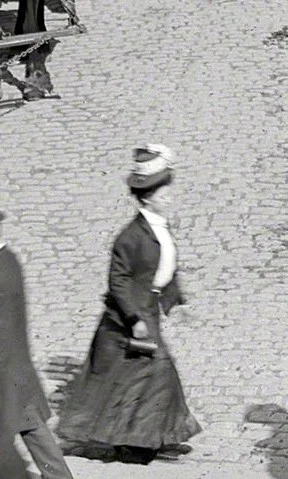
Here, for example, is the Wabash Avenue L in 1900. It seems to be mostly about rails and facades, but an attentive commenter picked out this lady.

We’ll never know where she was headed

We’ll never know where she was headed

This is probably not the main character of a story, but a supporting player who rivets the attention whenever she's onstage. Where did she go once she strode off the edge of this photograph?


Also in Chicago, this time under the L, in 1940, are people dressed in the much lighter summer clothes of four decades later.

Chicago, Under the L, 1940

Chicago, Under the L, 1940

My eye is instantly riveted by this lady, who really knows how to make getting from one place to another an adventure. Her way of moving is even more impressive when you reflect that she's doing it in heels across paving stones and streetcar tracks.

“Don’t just get somewhere, go there!”

“Don’t just get somewhere, go there!”

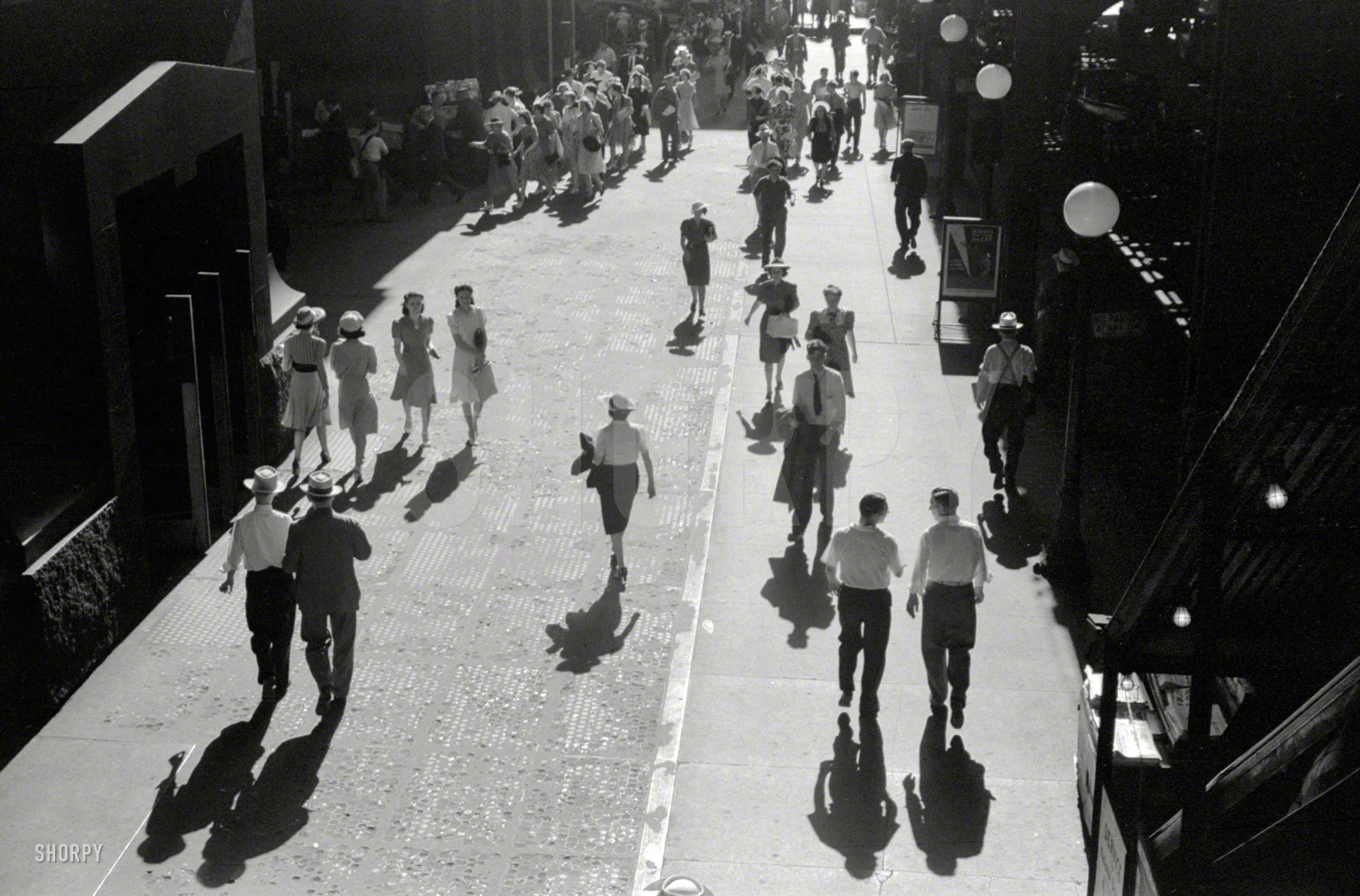
And, finally, a scene before the war. Another summer afternoon, just a year later than the previous one, right after work. You see women in summer dresses, older men in hats, younger men bareheaded. Everyone's going somewhere, but in no rush, so I haven't picked anyone out in particular.

A Chicago, the summer before the war

A Chicago, the summer before the war

Businesslike Bostonians

This shows the end of Bromfield Street in 1908, right where it joins Washington Street. The street looks pretty much the same today. Marliave is still there. That's the Granary Burial Ground at the far end.

A bit less horse poop, but much the same in 2018

A bit less horse poop, but much the same in 2018

I hope she made it on time

I hope she made it on time

It looks like the morning commute. My eye is always caught by this lady, hustling to work, not particularly enjoying herself. I've never figured out if that's her lunch she's carrying, her purse, or a beer stein.

He, on the other hand, doesn’t have to worry about getting there on time. They’ll wait.

He, on the other hand, doesn’t have to worry about getting there on time. They’ll wait.

Meanwhile, the men look more relaxed. This older gentleman, very well dressed, is looking at the scene, while the two younger men behind him, saunter toward Tremont Street, one with his hands in his pockets.


Then here is what is now Dewey Square, in front of South Station, 1905. The Station has lost much of its bulk over the years, so each wing is shorter, and the elevated train is gone. I actually like elevateds, but most people find them noisy and unsightly. If they're paid for and are working, I'd keep them. Boston went through a lot of effort to bury theirs, and at great expense, though this one was gone long before that.

In the summer months there is a great farmers’ market here

In the summer months there is a great farmers’ market here

“He had pies in both hands, I’m telling you….”

“He had pies in both hands, I’m telling you….”

Lots of people walking in various ways, but I like these two, who, yes, are standing, not walking: a cop in a classic custodian helmet (now associated only with Keystone Kops) and a shorter guy with something to say, standing on a slight slope so that he has a comic look perfect for one of those Mack Sennett two reelers.

Popping the Cork: What Caused the Rise of the Colorado Plateau?

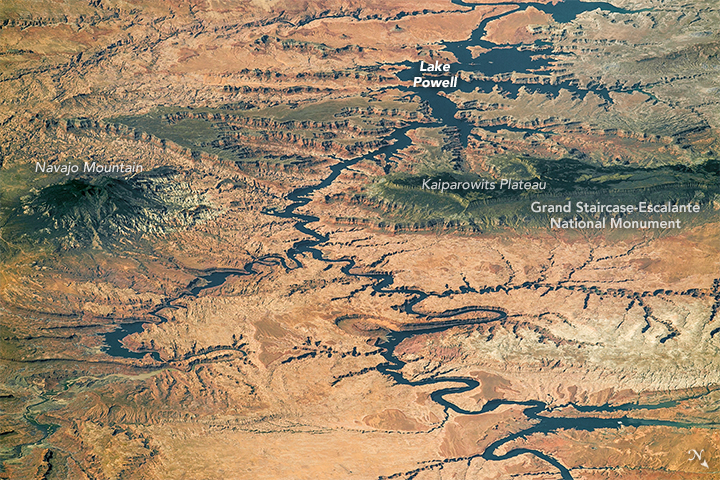
A couple of weeks ago I discussed geology, the Colorado Plateau, and the mysteries of the plateau's uplift, and promised a possible explanation.

The Colorado Plateau from space (NASA Earth Observatory)

The Colorado Plateau from space (NASA Earth Observatory)

Aside from finding this stuff interesting in its own right, I'm hoping that great knowledge of these geological processes and the various ways in which visible landforms are created will enable me to create more credible and realistic geology for any fictional settings I come up with. For example, in one story I want to have a copper mine in a mountain setting. Is that even possible? How are copper deposits created and how do they end up where they are? I don't have the answer to that yet, but just popping it into a picturesque location without giving these questions due consideration is not something I want to do.

Plate tectonics and grizzled Colorado Plateau geologists

One of my go-to Colorado Plateau books is The Colorado Plateau, a Geologic History (2000), by Donald Baars. Near the end, Baars explains his caution about going all-in on plate tectonics, in a section cleverly titled Geophysics or Metaphysics?:

Over the past couple of decades, it has become quite fashionable in the geological community to relate all structural episodes such as described for the Colorado Plateau to "plate tectonics"...the concept of plate tectonics may be likened to a new religion. Since hard facts are lacking, if one is not a "believer" one is considered an "atheist" with regard to the many theories and interpretations of the "clergy": the oceanographers and geophysicists.

Note that while my edition of Baars is from 2000, it is a revision of an earlier work. Baars points out a variety of problems with the application of plate tectonics to Colorado Plateau geology, and his point is well taken: there are many geological processes that are only remotely related to plate tectonics. My excerpt skips over much of his reasoning.

At least he discusses it, though the scare quotes hint at some traumatic conference encounters with arrogant young pups pumped with the gospel of plate tectonics. In his otherwise admirably thorough Geological Evolution of the Colorado Plateau of Eastern Utah and Western Colorado (2011), Robert Fillmore barely mentions it.

The useful disappearance of the Farallon Plate

A currently popular theory that explains not only the Colorado Plateau, but the Front Range of the Rockies and the Basin and Range province involves the subduction and disappearance of the Farallon Plate under the North American Plate. Actually, as you might expect, the Colorado Plateau is very much an afterthought in this theory, and is more ambiguously a consequence of it than some other things. Note: the diagrams are from the fine book, Rough-Hewn Land, a Geologic Journey from California to the Rocky Mountains, by Keith Meldahl, which I will go into in more detail in a later post.

Very briefly, the Farallon Plate, an oceanic plate, was west of the North American Plate, a continental plate. They moved toward each other, making a convergent plate boundary. As happens in these cases, between 110 and 85 million years ago, the lighter continental plate rode up over the heavier oceanic plate, and the Farallon Plate dove under the North American Plate, in a process called subduction. That generated magma, which rose up and resulted in what is now the Sierra Nevada range. This is fairly common. The Andes and other mountain ranges are caused by the same process.

The first two phases (from Meldahl)

The first two phases (from Meldahl)

But then the Farallon Plate did something less common. Instead of continuing to subduct steeply, about 80 to 45 million years ago it flattened out, and slid under the North American Plate without continuing to dive and melt. There are various explanations for why this happened which I won't go into here. Since it didn't melt, it went much farther than it usually would have, eventually shoving up the Rocky Mountains, way farther from the continental plate boundary than mountains usually form. This is called the Laramide Orogeny, which for a long time was just a mysterious and evocative term in the books I read to try to understand things. I really didn't.

At this same time, the cork of the Colorado Plateau was also forced up, but did not get as deformed as the rocks in the new mountains.

Then, 43 to 21 million years ago, the Farallon Plate resumed a normal pattern of steep subduction. Gigantic volcanoes erupted all over what would become the future Great Basin, west of the Colorado Plateau. A lot of the mineral wealth of the area comes from this time.

The third and fourth phases (from Meldahl)

The third and fourth phases (from Meldahl)

In the last 20 million years the North American Plate rode right up over the Farallon-Pacific Ridge, which is where the seafloor spreading that fed the Farallon Plate occurred. Cut off from a source of new crust, the Farallon Plate stopped growing, sank, and vanished. The result was a upwelling of hot mantle rock that stretched the crust and created the Basin and Range and its north-south ranges of mountains: the landscape of much of the desert West. As I mentioned earlier, the rift valley of the Rio Grande is also part of this same stretching.

Always a bit player

You will notice that the Colorado Plateau is again an afterthought. The real action is in the east, where the Rockies form, and to the west, where the Great Basin emerges. The Colorado Plateau is the Haydn of geology, too calm and well-mannered to get the same attention as Beethoven and Mozart. It just keeps on composing geological symphonies.

Now, the detailed geology of the Colorado Plateau has a lot of specific interest, and I've used it in my own work. But this is enough for today.

Is this at all how you understand things?

Figuring this out has really enabled me to get the Colorado Plateau in a way I didn't before. Do you need this kind of fundamental explanation to appreciate things, or can you live with more specific knowledge?

The Merits of Having a Garden

One of the things I got back when I returned to the house was my garden. When I lived in the post-divorce apartment, I was above it all. I had a front porch, but no real contact with the soil. It was fine.

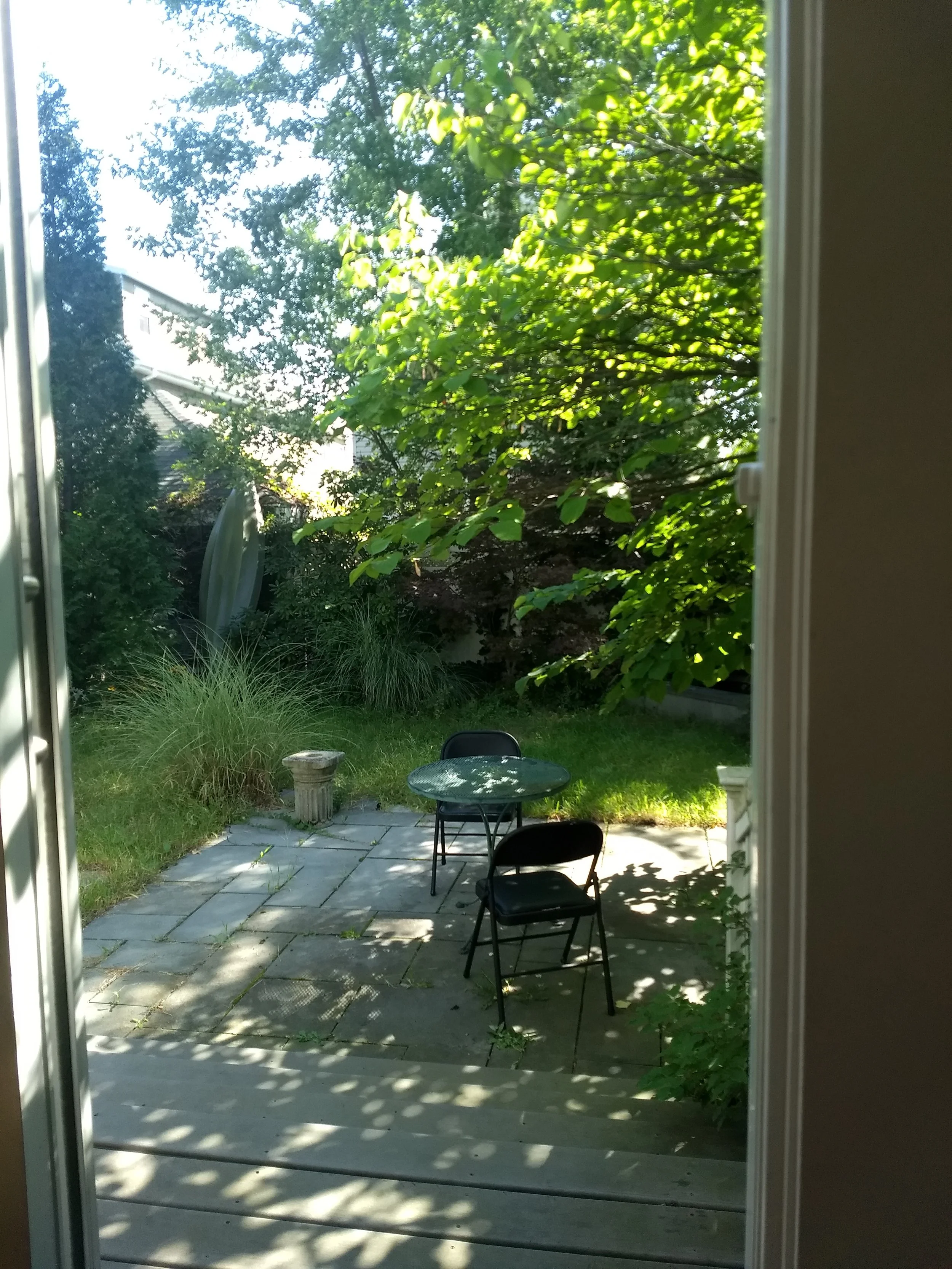
My current office (a corner of the dining room) overlooks the back yard. The bushes and trees were much overgrown when I returned and many of the perennials gone. I won't prune much until next year, since winter is on its way, though I am taking some of the bamboo back. I do get to feed the fish in the small pool every day. Nothing exotic, just thirty-nine cent goldfish that have grown surprisingly large. I can't really tell them from koi anyway, because I'm a total heathen.

But I go out every day and walk around and check things out, think about what I want to do next spring. Most of the butterfly garden is gone. Some years ago I had a neighbor whose back yard abutted on the yard of our triple decker. I was just starting to garden then, and Sinclair's garden was quite impressive. And every day she would get home from her job at MIT, and would walk around it with a drink and a cigarette, considering its many details. She really looked at it.

From my desk, again

From my desk, again

So I try to channel her, and really feel what the garden is, and what might be changed. Sinclair would readily move plants, just to see if things could be improved. She gave me much advice across the back fence, and she was one of my favorite neighbors of all time.

My next door neighbor Lisa is a gardener too, as well as another writer, so I do have another compatriot.

There is not much to be done to it now, so I am not tempted away from my desk. But I do enjoy going out to look at it, while thinking about something. I almost called this post "the perils of having a garden". But that's really wrong. Writing feels more like growing things than building things, and the problems of rearranging things, only to find that a plot point or character does not like its new surroundings, has similarities to managing a garden as well.

But writers are prone to elaborate metaphors, so I'll stop there. Still, taking care of something that will only gradually become something, is the perfect pace to relax the mind from the frustrations of making stuff up. For now, I'll chalk that up as a time benefit. Next spring, I may have a different report for you.

Essential Writer Skill: Drinking Cheap

I like a good cocktail. So I also like a good cocktail podcast. Particularly a cocktail podcast that helps me save money while still enjoying myself.

The Daily Beast's Life Behind Bars is maybe a bit looser than I typically like my podcasts. A lot of people seem to like listening to hours and hours of people sitting around chatting. I don't particularly like chit chat or banter unless I am actually participating in it, and prefer for podcasts to be severely edited before I let them in my ears. Don't waste my time, or I'll listen to you at 1.5x or even faster.

That said, Noah Rothbaum and David Wondrich are entertaining enough, and have a great deal of information to impart. Of course, a lot of cocktail discussion seems to be about who invented what, what the original recipe was, and other such matters that seem to be a topic solely to have something to argue about.

Episode 13 was about the Manhattan, probably my favorite cocktail. In the course of this episode, David Wondrich told a story about a test he once gave some bartenders. They were given Sidecars to taste. One was made with the original, high quality ingredients: Cognac, Cointreau, and lemon juice. One was made with California brandy, triple sec, and lemon juice.

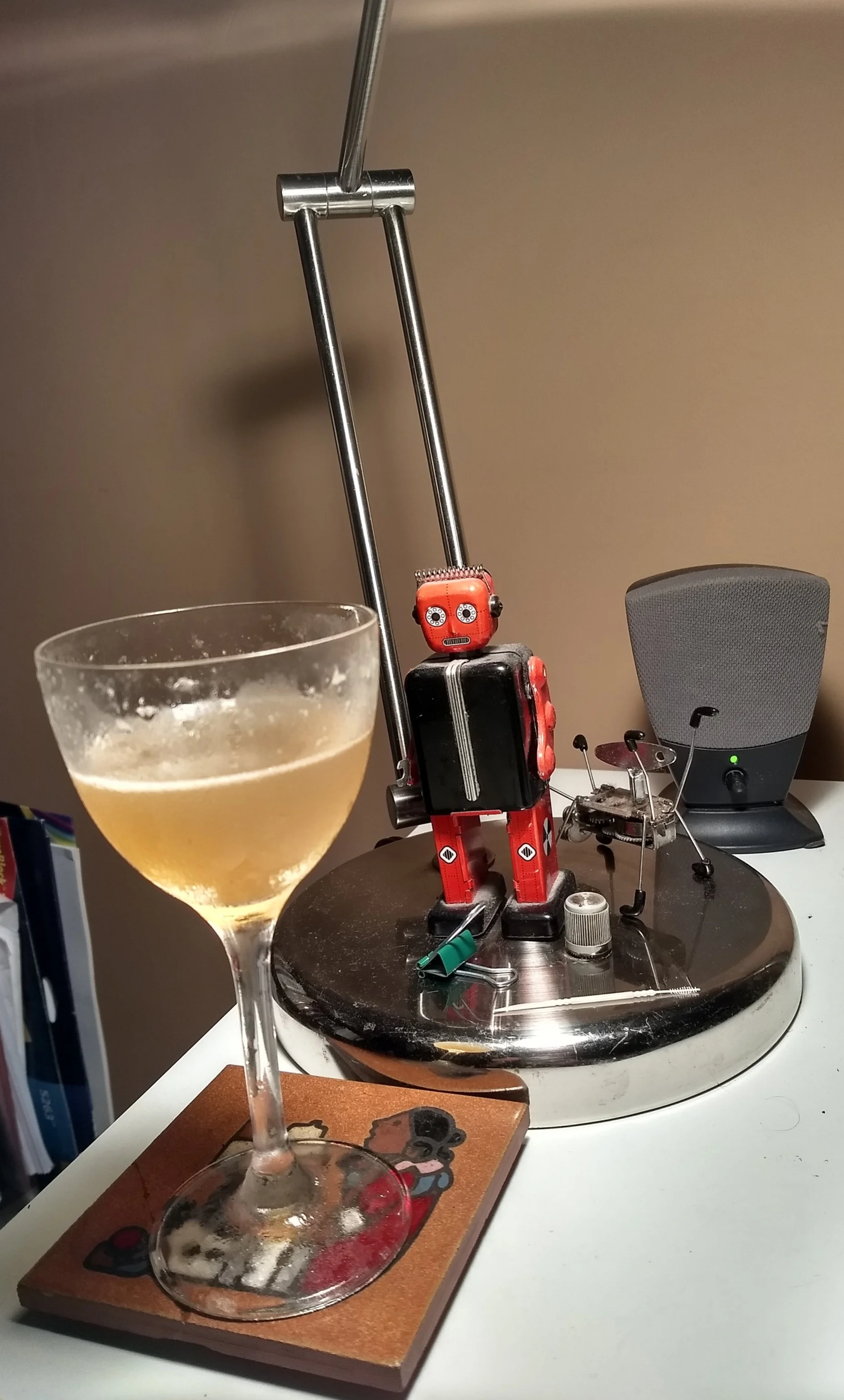
The robot is flabbergasted by this new intruder on the desktop

The robot is flabbergasted by this new intruder on the desktop

David tasted them also, and had to admit that it was almost impossible to tell the difference. I felt a moment of revelation. I like a good Sidecar, but the standard ingredients are a bit expensive for me to justify. But after this I ran out and got some E&J brandy. My home orange liqueur is Luxardo Triplum, so not a bottom level triple sec, but certainly not Cointreau.

This is a great Sidecar! Basic ingredients are pretty good these days. Fresh citrus juice is really the defining feature of any drink where it's an ingredient. Squeeze it right before you make your cocktail and you're golden.

There are a number of different ratios you can find for a Sidecar. I don't like remembering a lot, so I do two parts brandy, one part triple sec, one part lemon juice. I don't put sugar around the rim, though I might if I serve it to someone else. You might bump up the triple sec if you want it a bit sweeter.

I got a lot done today, and also sent a story off to my writing workshop for our next meeting, so I justified one, even though it's pretty late in the evening as I write this. Save your fancy Cognac or Armagnac for a snifter, squeeze a lemon, grab some basic brandy and triple sec, shake it up, and enjoy yourself.

You're welcome.

Do you have a favorite cocktail?

It says less about you than people like to think, but it is something to consider.

Normal is the Rarest Thing: Eighth Grade

Kids and teens in movies tend to be verbal, clever, quick, culturally aware, and sassy. To use the inevitable cliche, "wise beyond their years". They observe the events around themselves mordantly, understanding the hidden motivations of those they have to deal with. They might be, often are, horrifically oppressed by those who are dumber and less worthy than them, but who have a temporary ascendancy through circumstances, age, or legal authority. Eventually these clever kids manage to figure out a way out of their seemingly impossible situation, all while making pertinent and well-constructed observations.

Eighth Grade is nothing like that.

Life as it is lived

Kayla, the main character of the movie, is, well, normal. She is smart, but not that smart. She tries to be articulate, but talks like teens normally do, with lots of spacers words, like "like", hesitations, wanderings, assertions immediately softened, and sentences that end somewhere completely different than where they started. She is more potential than actual.

Kayla uses highly social media

Kayla uses highly social media

She wants pretty much what everyone else wants. She wants to look better than she does—the actress, Elsie Fisher, had a significant case of acne, which apparently had made her hard to cast in other roles. It was real life adolescent skin. In one clever moment, Kayla spends quite a bit of time in the morning putting on concealer while watching a YouTube video. Then she gets back into bed and takes a picture of herself, affecting to be dismayed at how she looks right out of bed.

She has her own, barely watched, YouTube channel, where she gives others the life advice she herself has so much trouble following.

When real life situations get difficult, she genuinely does not know what to do. At one point a boy, older than her, tries to take advantage of her vulnerability, and when she resists, gets all pouty, and they both implicitly agree that it is all her fault. It's a brilliantly paced and excruciating scene, and the fact that what happened will never be seen or resolved is part of its power. It's not a tragedy, just the kind of thing that happens.

Is this really a movie?

Movies are a realistic medium, but often bootleg in theatrical techniques when they want to juice things up. Eighth Grade has the courage of its convictions. The incidents are small, the people involved flawed, the connections fleeting or missed. Kayla's father loves her, though she finds him just as exasperating as any thirteen year old finds their parent. Having been a befuddled dad myself, I am totally sympathetic with his position.

Everyone is on screens, but the movie has no "position" on this. It is neither good nor bad, it is just the way these people live, the water they swim in. That observational position is perhaps the bravest choice of all. The kids are just kids, as clueless or mean or loving as they always were, just in a new idiom. There is no deep tragedy here, either personal or societal.

It also helped that it didn't have any actors in it that I recognized.

Should you see it?

I'd say definitely. My date, who has a child that age, was very moved by it. I didn't cry myself, but I'm tough that way.

When you see the movie, let me know what you thought.

Cratons and Rift Valleys: the Bobbing Cork of the Colorado Plateau

Last week, I wrote about how little I actually know about geology. But, still, I am resolved to understand something about where my beloved Colorado Plateau came from.

Here is what I have puzzled out.

The Colorado Plateau is a big chunk of craton (a great word I originally learned from John McPhee...whom I will get to in due time). Craton is defined as crust that hasn't been affected by mountain building for at least a billion years—and you thought your home town had nothing going on. Cratons can either be shields, where old metamorphic and igneous rocks are on the surface (the Canadian Shield, for example), and cratonic platforms, where there are sedimentary rocks piled up on top of the thick ancient rock.

The Colorado Platform is a roughly circular chunk of cratonic platform, surrounded by mountains. Its thick basement rock is covered with many layers of sedimentary rock. And it has rotated a bit clockwise, which has opened up a rift valley to its east, the Rio Grande Rift, through which the river of the same name now flows.

About 17 million years ago, the Colorado Plateau kind of bobbed up, causing a big increase in erosion. Snow fell on its higher elevations, increasing the amount of water flowing in a dry environment.

Yeah, I should show you a map of where it is—try to ignore the fact that the mapmaker didn’t know how to spell “plateau”

Yeah, I should show you a map of where it is—try to ignore the fact that the mapmaker didn’t know how to spell “plateau”

A lot of other stuff happened over that time, of course, from hot spots that punched mountains through the cratonic crust to salt valleys. And what caused the plateau to rise up like that is a subject of some debate. In the future I'll get to a popular possible cause, involving a disappearing tectonic plate, which resulted in, among other things, the anomalous position of the Rocky Mountains (no, I did not realize their position was anomalous either).

Different languages, different approaches

None of the geology books I own about the specific geology of the Colorado Plateau ever use the word "craton", or ever bother to explain, in basic terms, what makes the Colorado Plateau the Colorado Plateau. They mostly give a quick overview of rock types, geologic processes, and geologic time, and then launch into insanely detailed descriptions of the origins of Navaho Sandstone and the Ali Baba Member of the Moenkopi Formation. That's fine, I guess, but it never got to what I wanted to know, which was what was different about this place.

If they'd just said "it's kind of like a raft of ancient rock, separate from the Basin and Range and mountain areas around it, a raft covered with layers and layers of sedimentary rock, which got pushed up and started to erode much more quickly", I'd have had an image to hold on to, a way of organizing my thinking.

But don't rely on me

But I'm not expert. And, as I said before, geologists either seem to write about the Colorado Plateau, or everything but the Colorado Plateau. John McPhee, in his many books about geology over the decades, collected a couple of decades ago into the omnibus Annals of the Former World, mentions it only once, while discussing something else. A lovely book called Rough-Hewn Land, by Keith Heyer Meldahl, is subtitled "A Geologic Journey from California to the Rocky Mountains" and taught me a lot, but deftly dodges around the Colorado Plateau in its eastward journey in an almost perverse way.

By that point I was taking this kind of personally. Sometimes it would appear on a map, but not be mentioned in the text. Sometimes it would lurk just off the edge of the map. There was almost a feeling to trauma to the whole thing, as if something so horrific had happened there that no geologist could manage to even remember having learned about the place.

My Essentials of Geology by Stephen Marshak, a book I have found quite useful, actually does mention the Plateau, and points out its cratonic nature in a map of the cratons of North America. But it too does not spend much time on it.

So a lot of what I have here I've kind of pieced together. The Colorado Plateau is a raft, or a cork (I like that because it's roughly circular), a block of rock of long standing, which has been a single unit for a really long time, has gotten covered with sedimentary rock and partly eroded quite a few times, but only in recent eras has floated up so high that it has eroded in a way that makes it so cool to visit.

I'll get into more detail on that when I get a chance.

So what gives?

What happened among those geologists? Was there really some terrible disaster that left most geologists denying that there even is such a place, while sunburned, dust-spitting characters in worn boots stumble out of the dry wilderness with improbable tales of the De Chelly erg and the Dewey Bridge Member while never really getting clear about where they have been? Do these two groups talk, or do they carefully never acknowledge each others' existences?

There is a story here, of course. If necessary, I'll make it up.

What Happened to My Office?

Doesn't look too bad, does it?

Doesn't look too bad, does it?

As I mentioned last week, I've moved back into my house from my post-divorce apartment. My former wife has moved out to what sounds like a nice apartment nearby, easy for the kids to move between.

Context helps. Of course, a lot of that stuff is temporary

Context helps. Of course, a lot of that stuff is temporary

But what I did lose my nice small office, on an enclosed porch with lots of windows. Last time I was in this house, the kids were younger, and I worked diligently in a basement office. I was down there for years, but never really liked it.

A bit bedraggled, but every writer needs a garden to take care of

A bit bedraggled, but every writer needs a garden to take care of

So I'm not moving back down there, not right now anyway. Instead, I have set up in the dining room. It's kind of exposed, but then, only my son is currently here, and his schedule is such that he is not usually hanging around here.

The consolation is a nice view of the garden from my seat. Yes, it's kind of bedraggled. It's a fair amount of work to maintain a garden, and no one else in the house was up for it.

So, for now, that's where I am. Let's all keep an eye on my productivity, and we'll see how I do.

Where do you prefer your office?

Or do you even need one?

Geology: the Missing Science

Doesn't that sound like the title of one of those ancient textbooks you could find in the back stacks of school libraries? Still, as far as science fiction goes, geology does not have a big role.

I did not grow up studying, or at all interested in geology. It helps that I grew up in Illinois, where all is glacial till, and bedrock only emerges at odd locations, like Starved Rock State Park, a favorite place to visit and climb around in my childhood. You are no longer allowed to climb around there, but we used to do incredibly dangerous things. That's what geology is for. And then I moved from one glacial landscape to another, New England, all drumlins and the traces of glacial lakes. There are a lot more things you can fall off of out here, though, so that was some progress.

Fun fact: if you Google "geology", pretty much all the top images are of the Colorado Plateau

Fun fact: if you Google "geology", pretty much all the top images are of the Colorado Plateau

I only developed an interest in geology when I started spending a lot of time on the Colorado Plateau, around Four Corners, the area that holds most of the famous national parks of the Southwest, like Zion, Bryce, the Grand Canyon, and Canyonlands. Geology there is bold and in your face.

I've set one story specifically there, in the future in Escalante Canyon ("The Breath of Suspension"), and several in an area of an alien planet that is similar to the Colorado Plateau (the Tessa Wolholme stories, "Above Ancient Seas" and "The Last Castle of Christmas"—I really should get back to that world....)

Geology strong affects what humans do, how they live, and how their world looks and feels.

Enjoying it is one thing, understanding it is quite another

Over the years, I acquired a number of books and wall charts on the geology of the region. I would read them, trying to distinguish the various geologic eras I was looking at (from the deep Paleozoic at the bottom of the Grand Canyon, through the Mesozoic strata in Zion, to the youngest rock in Bryce, halfway into the Cenozoic). I'd see how all of these locations are part of one gigantic multilayered structure, the Grand Staircase. Even when I was successful, I still didn't really get what was going on with the Colorado Plateau.

So, recently, after my last trip there (Boulder Mail Trail, Escalante Canyon) I decided to learn a bit more about geology in general. That doesn't mean that I got all interested in the things like the Moh's Scale of mineral hardness, which every geology text feels obliged to spend some time on. I know diamonds are harder than talc. Don't push me any farther. But I did want to figure out how the land had formed,and what in particular made the region of the Colorado Plateau so specifically interesting.

Several levels of explanation

One interesting thing I found was that there are some quite good books on the geology of the Colorado Plateau specifically, and some good popular and lightly technical books on geology in general, but they don't overlap much. Larger scale geology books and textbooks seem uninterested in the Colorado Plateau, while the more regional books spend little or no time on the larger picture into which the Colorado Plateau fits. I get the impression that canyon country geologists are their own breed, somewhat crusty, somewhat stuck in their ways, kind of like Boomer science fiction writers. Geologists from other regions are reluctant to mess with them, or trespass on their turf. Or maybe, more properly, their caliche. In several of the books I read, they were dubious about plate tectonics. The books are a decade or two old, and they couched their objections as anyone with a working set of analytical tools usually does: "hey, let's not go overboard here, this is cool, but we should be careful about using it to explain everything" followed by a muttered "punk kids think they can tell me how to look at a landscape."

So, next time, we'll check out cratons, the rift valley of the Rio Grande, and other such interesting matters.

How much do you know about your geology?

I was on a panel at Readercon, and someone in the audience wanted to talk about leaving your body to science. I wondered if you were allowed to pick which science, and whether anyone ever left their body to geology. None of the mortuaries around here seem to offer fossilization as an option.

The Big Move

Right now, I'm in the midst of packing to move. A huge proportion of my possessions are books, even in this electronic era, and those are mostly packed. Still, those are what makes this more of a trial than it needs to be.

Some of my books

Some of my books

I moved to this apartment when my marriage ended, four years ago. Now I'm buying my ex-wife out and moving back to the house, and she is moving to her own apartment. Don't ask me if this is a wise financial decision. There is a lot of sentiment involved, perhaps a bit too much.

Interestingly, though I am moving from an apartment to a house, the quality of my writing area will decrease. Right now my office is a weatherized porch on the second floor, just off the kitchen. It's a smallish room with good light, and just enough room for my desk, a table for the printer, and a bookshelf.

More of my books. Not my worst habit.

More of my books. Not my worst habit.

The house has no real space for a separate office. I'm not ready to confiscate a bedroom from one of my two kids, even though one of them is off at college. So it will either be back to the basement, where I worked for so many years, or in a space in the dining room. My dining room gets more use than some, because I like having people over, but maybe I'll turn the space into a hybrid library/office/dining room. It does have a nice sliding glass door opening out on my garden, which is currently an overgrown mess. Bringing that thing back to life is my first goal.

I used to have a big garden party in the late summer for all of my writer and writing associated friends. My then-wife never liked it, and I missed a couple, and then moved out. I don't know if I can manage to schedule one before the weather cools down and gets too unpredictable.

This is what passes for exciting news in the life of a writer! Packing. Dismantling things. Fretting about where the moving truck is going to park. Yeah, you have no idea.

Maybe You Should Exercise a Bit

There really are only two things we know about how our actions are affecting our health. I don't know you. I've never met you. But I know (statistically) two things you should try to do:

  • Eat a little less
  • Exercise a bit more

Sadly, pretty much everything is in there. And even if I'm wrong...well, you know I'm not wrong.

We really do like reading things we already know

Well, he was attacking me with a banana

Well, he was attacking me with a banana

Still, newspapers and websites need to fill space, and some of us have an insatiable urge to read about diet and exercise, just as some of us like reading about organizing things. As you may have guessed, I'm guilty of both. Reading about it is a partial replacement for actually doing it, whatever "it" is.

And The New York Times writes about exercise all the time, particularly in their somewhat loosely named Science section (Tuesdays). Often they cite studies of various sorts. "Studies show". We all know studies show that virtually every study is misleading.

Gretchen Reynolds seems to get the duty of spinning some tiny study involving eighteen people who only ate standing up for two weeks or something (not a real study...as far as I am aware) into a plausible-seeming article about health.

Last week it was about how our experience in gym class in our youth affects our attitude toward exercise in adulthood. It's based on that gold standard of high-quality studies, the online questionnaire. Yeah, you should probably stop reading right now.

Did you hate gym class? Does it matter?

The subhead of the article starts with the observation that people who filled out the survey "tended to harbor vivid memories of gym class". Because that's the kind of person who wanders around the internet filling out lengthy online questionnaires about immensely tedious topics like how you felt about gym class! And like all these articles, they cite what people say about why they don't exercise as a cause, rather than an excuse. "Thirty years ago I hated gym class, so I can't bear the idea of getting off the couch now". I don't know why people bother. Why not say "I don't exercise. I don't like it. Go away"? Own it!

Look, I get it. I was inept as a child and young adult. Picked last, slow, clumsy, and bored. I never really found gym class interesting or useful. I never looked forward to it. I would find some similarly malfunctioning friend and hang out in the outfield talking and hoping no one would hit anything in our direction.

Now I exercise a fair amount. I lift, I run, I bike, I enjoy the hell out of it. I would still be miserable at kickball, and apprehensive at the idea of trying to hit a thrown baseball with a stick. Someone I went out with recently told me that a friend of hers observed that no one ever came back from going out to exercise saying "man, I wish I hadn't done that". I hope she goes out with me again. People with interesting friends are always the best people to know.

Exercise makes you feel better, even if exercise itself doesn't always feel great. Gym class didn't teach me anything about that.

Now, maybe gym classes should. They should focus on finding things that are relatively fun to do that get your heart pumping, build muscle, and maintain flexibility. It should help you build lifelong habits that make your life long.

Because habit is everything, intention almost nothing.

I still don't think your memories of gym class have anything to do with it.

What habit do you wish you had?

And which one did you wish you didn't?

The Vacuous Horror of Word Forms That Are Not Forms

I recently received a Word form to fill out. You know the kind—a bunch of questions, and then, after each one, a line made out of a series of underline characters. Presumably this is meant to be printed out and filled in by hand, but usually the spacing between the lines is too narrow for actual handwriting. And no one wants a handwritten form back in the mail.

And here I thought everyone loved forms 

And here I thought everyone loved forms


So you're clearly expected to fill it out in Word, or whatever program you favor. As soon as you start to type the information, the collection of underlines moves to the right, eventually wrapping and messing up the alignment of everything else on the page.

Often these spaces don't have enough room for the requested information, so even if you spend time to delete the extra underlines (yes, some people do do that), you still have to mess up the rest of the page, making the document hard to read, and stupid-looking to boot.

I can't tell you how many of these things I've gotten over the years. HR departments are particular offenders, in my experience, but all sorts of seemingly competent people create them.

Forms are an important interface with customers

Now there's a nerdy pronouncement for you. Nevertheless, it's true. My day job is marketing, and on the rare occasions when I've had the authority, I've tried to make sure any forms we send out are clear, easy to fill out, and don't ask any unnecessary questions.

Before we get to how to easily solve the "underline cascade" problem, it's worth thinking about the unnecessary question thing.

It's also startling how many questions people add to forms just...because. They aren't interested in the answer, in fact often don't even look at it or record it. They just know you should ask if the person is married, or owns a dog that weighs more than five pounds, or enjoys Scrabble.

Once I helped a Behavioral Health department remove almost a dozen questions from a complex form just by asking who tracked that piece of information. They'd been using the form for years. In fact, they just copied it over—they'd lost the original.

Your customers interact with you in a variety of ways, and forms, both paper and online, are a key one. Don't torture them. Subliminally, that makes you look like a jerk. Do you really want your customer to think you're a jerk? Except in certain types of business, mostly aimed at males in late adolescence, I'd say no.

Use fields, for heaven's sake

In the copy brief questionnaire I use for new clients, each free text answer is a field. You tab between them, and you can't actually write anywhere else on the form. They expand to contain the text you put into them. The form does get longer, but nothing reflows.

(And if you're someone who'd like some good marketing content, you should head on over to Sturdy Words, my freelance marketing website, and check it out)

Word fields are stupid easy to use. Word is an incredibly capable program, and almost no one uses it anywhere near its full capability. You can put in fields that will expect a zip code, or a date, or whatever exact thing you want, as well as free text.

I resisted the urge to fix this company's form, as I have, in the past, resisted fixing forms HR has sent me. That's just a sickness, and I struggle against it. Of course, if someone wants to pay me to fix their forms, I'm delighted to do it.

What are your company interface pet peeves?

And what solutions do you stop yourself from providing?

The Crises of the Stuart Century: Wrap Up

If you need to catch up, my posts about the Crises of the Stuart Century were:

Yep, that pretty much covers it.

Yep, that pretty much covers it.

So why am I going on about the various political conflicts during the seventeenth century? Well a number of reasons, and it might be useful to go through them, so you understand what I'm about, as well as how what I'm about influences my work.

  1. It's interesting. Now, this is largely subjective. Usually, when people talk about why they don't like history, they mention "memorizing dates". People learn sports stats, the details of who wrote a favorite song and under what circumstances, or how to roast a goose. To think productively about something, you have to know something about it. Yes, I know this is probably an unpopular and even problematic attitude nowadays. Nevertheless, it remains true.I happen to enjoy learning about the actions and misbehaviors of influential or interesting people of the past, and the characters of 17th century England were certainly interesting. To celebrate, I just put on Edward German's "Nell Gwyn Overture", a cute piece of incidental music from 1900. Let not poor Nelly starve--if she could have gotten royalties from her future fame, Charles would not have had to make this plea to his brother James on his deathbed.

  2. It tells us a lot about the origins of our political system. Yeah, I know. That sounds a bit too wholesome and improving. Still, it really is fascinating to try to inhabit the mental world of people who don't know that someday there will be filibusters and primaries. Now, yes, a narrative of steady progress toward freedom is not tenable. But still, it is startling how every attempt to reassert Royal prerogative was successfully opposed, sometimes with violence, sometimes with Parliamentary maneuverings. People recognized rights, and defended them. Reading their arguments, seeing their positions, and understanding their ambitions, shows us what is functional in a political system, and what isn't.

  3. It reflects our own time, sometimes in disturbing ways. This is what struck me the most as I read the book. The Stuart century starts with a fairly ordinary royal administration under James I. Then it falls apart into brutal civil war and ends in a military dictatorship. The large-scale collapse of civil government, leading the widespread violence and death, in a country not threatened from outside, is quite disturbing, though it did come in the middle of a century that seemed devoted to senseless ideologically and theologically driven violence. In England ideology and interest overwhelmed a sense of common nationhood. And, after all that, no one had a working government model to replace the one that had been destroyed. A military dictatorship ensued, but only because they had a supernaturally skilled military and political leader, Oliver Cromwell, to be military dictator. And he never came up with a system that would go of itself. Once he died, they had no choice but to return to the royal system they had so violently destroyed.

But once you've killed a King, and run things pretty successfully without one for awhile, can a King ever feel completely secure? The body politic under Charles II was disordered, violent, moody, and more than a little deranged. And their King and his brother, the heir, were both in the pay of the King of France. Patriotism doesn't pay the bills after all. So vast conspiracy theories convulsed the nation, leading to riots and executions. Our petty Vince Fosters and Seth Riches have nothing on Edmund Berry Godfrey lying in a ditch on Primrose hill, impaled on his own sword, or the attempted assassination of both the King and his successor.

When the next crisis came, a major part of the ruling clique invited a foreigner to come in and replace their legal monarch, and then just brazened it out: "I really don't get what you're going on about". We call this coup the Glorious Revolution, and, in fact, its somewhat low origins do not prevent this new period from being the fount of much of our thinking on the legitimacy of democratic government.

Then, safe at last, everyone, or at least everyone with the leisure to indulge themselves, sank into childish and vicious party rivalries over issues of little ultimate significance. That's the happy ending!

The Hobbes metric

Thomas Hobbes lived from 1588 (when his mother was supposedly frightened into labor by news of the approach of the Armada) to 1679. Someone similarly long lived born in 1625, the year Charles I became King, would have lived to 1716, two years into the reign of George I, the first Hanoverian monarch. King Charles would have been executed when they were 24, Cromwell become Lord Protector when they were 28, Charles II King when they were 36, and the Glorious Revolution when they were 63. Someone who lived in interesting times.

Do you think you'll see anything like that amount of political change over your life?

For all its flaws, our system has been remarkably stable. What are the chances that that will continue?

Dealing with Classical Music Hosts

I've previously been a jerk about "The Moldau". Now it's time be a jerk about on-air classical musical hosts.

It's not an easy job. How much information should you provide about each piece? How many unfamiliar pieces should you mix in with the old warhorses? And how many old warhorses should you include that are performed by unfamiliar orchestras, or with innovative interpretations? I get that there is more work involved than us listeners appreciate.

Chris Voss is annoyingly good looking too.

Chris Voss is annoyingly good looking too.

Still, you could have an interesting and pleasing personality. My home station is WCRB, though, weirdly, its player just will not load in Firefox, my default browser, so I have to have a separate Chrome window to listen to it. My favorite host by far is Chris Voss, on in the afternoons. I'm not quite sure what makes him so appealing. He is funny but not ingratiating, and seems to both love the music and be a regular guy you'd like to hang out with. I also don't get a sense of staleness from his programming choices.

I used to also really like another WCRB host, Lynnsay Maynard, who had that same afternoon slot. Then she disappeared. Earlier this week, I was listening to my other favorite station, All Classical Portland, and I recognized a familiar voice. It was Lynnsay! She seems to have moved out to the west coast. That's a pity, but at least I get to hear her again.

I can hear Lynnsay through the miracle of the internet

I can hear Lynnsay through the miracle of the internet

At All Classical Portland I do miss Robert McBride, who recently left. He was incredibly knowledgeable, and seemed to have met and interviewed almost everyone in the field. He seemed a bit austere, but always hopeful that we could appreciate what he was finding for us to listen to. And I've had a crush on Brandi Parisi since she was the overnight host, many years ago. She also teaches philosophy and seems to have cool-looking tattoos. She has distinct likes and dislikes, though she won't force them on you. I remember her very gently indicating to another host her dislike of Simone Dinnerstein's interpretation of the Goldberg Variations, which I appreciated even though I rather like Dinnerstein's Bach.

Classical hosts who fail tend to try to ingratiate themselves by being jokey when they clearly aren't at all funny, or by being a bit cutesy, as if we are all children in music appreciation class. Or by being dead boring. Though I said I was going to be a jerk, I really don't want to name people I don't like. There's a senior person at All Classical who is just dull.

And here in Boston we have a morning host I find simply appalling. I won't even listen until this person has safely left the air. My dentist is a WCRB listener, and he says he has another patient who loathes this host. If I didn't know he was a professional, I'd ask to meet this woman. Bitching about our shared dislike of the morning host would be a great first date. WCRB has a tradition of divisive morning hosts. For years it was Robert J. Lurtsema (chirping birds!) who drove some people crazy.

So, yeah, I've baited you with the internet's main currency, rage and denunciation, and instead given you a bunch of stuff I like, and been bizarrely discreet about my dislikes.

Do you have any hosts you particularly like...or don't?

You can remember ones from your childhood too. A good host can really open things up to a beginner...and a bad one can make the whole thing seem intolerable.

Are Writers Better Liars Than Other People?

From The Volokh Conspiracy, an interesting case of a criminal defendant on the stand being questioned about whether the fact that he is writing a work of fiction makes his story of events even less credible than it already is.

Haven't you always wanted to do this? (Shutterstock, from ABA Journal)

Haven't you always wanted to do this? (Shutterstock, from ABA Journal)

In Don't Trust the Defendant — He's a Novelist!, Eugene Volokh details how the prosecutor questioned the defendant on the stand about the novel he was working on. "But this book of yours is a work of fiction. But everything you're testifying here—now, you're telling us the truth today, aren't you?" the prosecutor says.

The defendant attempted to appeal, calling this line of questioning "nothing short of a character assassination".

We lie, but only in ways we know you will not actually believe

As a novelist, I am a bit distressed the idea that just mentioning someone is writing a novel is considered, by both sides, as bringing in something shameful and an indication of a deep character flaw.

Now, it seemed like the defendant, William Dangelo McKinney, had a lot of other evidence against him that he violently assaulted his girlfriend and then stabbed another man to death the next day, when that man came to pick the girlfriend up to take her to work.

There is a lot more to lying than coming up with a consistent narrative. There is a lot about demeanor, an understanding of what other people might or might not know, a sense of how the audience is taking the story, and a kind of low-level persistence that can masquerade as moral certainty. I'm not sure writers tend to have any of those in better supply than anyone else.

And we are certainly able to distinguish fiction from reality. That, in fact, is why we write fiction in the first place.

Should you be fined for being a novelist?

Volokh does not mention another distressing element of what happened to McKinney as a result of his foray into fiction. As the record of the appeal at McKinney v. State says in a footnote:

Although it is not apparent from the quoted portion of the record, McKinney asserts in his brief that the book was a "fictional romance novel." (McKinney's brief, p. 18.) The trial court imposed the $50,000 fine on McKinney, in part, "to make sure there's no opportunity for Mr. McKinney to profit" from publishing a novel.

A $50,000 fine for trying to write a novel? Would they similarly try to keep him from profiting from selling gardening services or even a nonfiction book on the history of hair styles? There is no indication that the novel relied for its plot or its proposed marketing on his crime. He had written the book a while before, during a previous stint in prison. It doesn't even indicate that it would take the first $50,000 of royalties, or something like that. It seems that the fine was imposed just for daring to write a book in the first place. And the $50K shows an overoptimistic view of what first published novels typically earn.

I'm not sure this case is the best one on which authors should take a stand, but I certainly it appalling that I could be charged with a crime, and then have an additional penalty imposed because I wrote a novel.

As any writer knows, writing a novel is its own punishment.

Do you think that a jury should take a fiction writer's profession into account while judging truthfulness?

And what other professions should we regard as suspiciously good at managing truth? Lawyers? Politicians? Marketing people? If the latter, I could be in for some kind of double punishment.

S-Town: the Self-important Blowhard as Culture Hero

In 2012 a depressed restorer of antique clocks wrote This American Life to tell the staff about an uninvestigated and unpunished murder in his home town of Woodstock, Alabama. Produce Brian Reed was intrigued enough to eventually go down to Woodstock, meet John B. and investigate the murder.

The podcast does have a great logo

The podcast does have a great logo

It turned out to have been no murder. John B. was totally wrong. But, for some reason, Reed found John B. fascinating and decided to investigate other things about his life. and turn the results into a podcast, S-Town ("Shit Town" being John B.'s nickname for his hometown). John B. committed suicide during production, and Reed then investigated that, uncovering John B.'s private sex life, among other things.

Reed affected to find John B. fascinating, and I, as podcast listener, was expected to do the same. Instead, I found John B. to be a tiresome blowhard. People claimed he was a fantastic restorer of antique clocks, a genuine expert. I don't even believe that, though my belief he was a faker even in that is unsupported by evidence, and is just prejudice on my part.

Talking a lot doesn't make you fascinating

We've all met people like John B., always talking about how much they read about all sorts of different topics and how deeply they've thought about everything. John B. provided no indication of understanding anything, and, in fact, seems to have poisoned himself with mercury while doing fire gilding...though that, like so many facts in this podcast, is never to be confirmed, since the autopsy did not check for mercury.

I still listened to the whole thing, because it kept promising to become more interesting than it actually ever did. And Reed is pretty good at digging around, and getting people to talk pretty freely. That's a real skill, and you do get some self-revelation from people, some of whom probably regretted being quite so open when the podcast finally was available.

We may be facing a shortage of genuinely compelling true crime

But the success of the podcast Serial has stimulated a lot of people to create multi-chapter investigations of past crimes and misbehavior. Serial itself never convinced me that its central character, Adnan Syed, was anything other than guilty. The BBC's Death in Ice Valley...well, I don't want to give spoilers, but I found it unsatisfying. These people do seem to play fair: if they are stymied, or can't figure something out, they don't pretend they have, and don't fake any kind of resolution if there is none.

But the problem is a lack of interesting unsolved crimes, fascinating locals, and evocative situations. That unfortunate shortage is pretty much why mystery fiction was invented. John B. is a typical serial liar, always rambling around the subject and trying to avoid giving away that he doesn't know a damn thing. I didn't get the appeal. I don't think the podcast did John B. any favors by exposing him to a wider audience, and most of the controversy the podcast aroused was about the invasion of privacy, not so much that John B. wasn't much worth listening to.

An actually interesting podcast: Reply All

By contrast, a podcast that is consistently interesting and showcases interesting people is Reply All. PJ Vogt and Alex Goldman always seem to find interesting puzzles, and then find interesting people to provide pieces of the explanation. Plus, Vogt and Goldman are incredibly funny, and give each other shit in a realistic and delightful way. I always learn something interesting from them.

So that's one thing. An interesting host (or two), who is skeptical, willing to dig deeper, and doesn't take anything at face value, can go a long way to making the story more interesting, even if sometimes they don't get all the way to the conclusion. In fact, at least once, they've reopened an investigation when they realized they'd actually reached a wrong, or at least incomplete, conclusion.

So that's my prejudice: I'd rather listen to smart people tell me about interesting true things than half-smart people bullshit me about pointlessly untrue or half-true things.

What serial podcasts do you like to listen to?

It's a genuinely interesting art form. Though I think Serial benefited quite a bit from great theme music, and its charming Mail Chimp ad, all of which turned it into something iconic. But don't forget The Nisha Call...actually, by the time it became an issue, I had totally forgotten the Nisha Call, and never bothered to go back and find out what it was. No, I don't want you to write and explain it to me.