My one big quote

The scholar John William Burgon is remembered for the last line of his prize poem Petra, describing that inaccessible city: "Rose-red city, half as old as time".  It seems he otherwise had a busy and productive scholarly career, but no one is interested in that.

One line?  At the moment, anyway, my internet fame comes from one line as well:  "The road to truth is long, and lined the entire way with annoying bastards".  It comes from my first book, Carve the Sky.  How it escaped into the wild is unknown, but it certainly has proliferated, most recently in the form of sweatshirts and hoodies.

There are certainly other usable lines in my work.  One a friend always uses is from my Future Boston story, "Focal Plane":  "An efficient technology is like the flu:  sooner or later you end up with it."

Or, boiled down from something Norbert Spillvagen says at the NEO Diner in Brain Thief: "Accept the cowgirl".  Now that I'd like to see on a T-shirt.


And I thought Amazon was my only hope

I checked the Brain Thief page on Amazon today, to see if there were any more reviews, and discovered that Amazon is no longer selling the book.  I have to admit, I sat there stunned for a bit, wondering if the shelf life of books had now gone below a month.  I looked around, and saw that other books, even quite popular ones, were not being sold by Amazon either.  What was the issue?

I found the answer, or at least the beginnings of one, on Tobias Buckell's site (Mr. Buckell is a better site for What's Going On Now, BTW--I'm much better on What Was Going On Then).  He links to a NY Times story that says that Amazon has pulled all books from Macmillan (which includes Tor Books), in an apparent dispute over Kindle pricing.

My book isn't even available on Kindle! Though I hope it will be at some point.  So my poor little book, already struggling to get sold, is now crushed like a butterfly under the gargantuan feet of two struggling saurians.

I hope this gets resolved quickly.  Given the state of the publishing market, this is not what any of us needs.  Meanwhile, if you are buying online, you can get Brain Thief at Barnes & Noble.

My Boskone schedule

I will be at Boskone Feb 12-14.  The usual mix of panels on topics I know nothing about!  But I think I can sign my name, so the autographic session should go just fine.

Friday  6pm        Boston as Setting

        Alexander Jablokov        (M)

        Toni L. P. Kelner    

        Paul G. Tremblay    

    The subway line to Cambridge inspired H.P. Lovecraft to visions of

    subterranean Antarctic horror; Hal Clement drowned Beantown under

    dozens of feet of water. Why Boston? Who's writing about here

    lately? What scenic SFnal possibilities does our fair city present?

    How can you convey its charm to readers who have never felt Boston's

    balmy February breeze?


 Friday  8:30pm     Reading (0.5 hrs)

        Alexander Jablokov    


 Saturday1pm        The Market(s) for Short Fiction

        Neil Clarke        (M)

        Elaine Isaak    

        Alexander Jablokov    

        James Patrick Kelly    

    Magazines, anthologies, the web? Find out where the short stuff

    sells, and how to get a piece of the action.

  Saturday2pm        The City and Science Fiction

        S. C. Butler    

        Alexander Jablokov        (M)

        James Patrick Kelly    

        Patrick Nielsen Hayden    

        Steven H. Silver    

    From the planet-spanning urbs of Trantor or Coruscant to the

    steamfunkier precincts of New Crobuzon to the vastly vertical

    Spearpoint of Alastair Reynolds  forthcoming Terminal World   what s

    your favorite skiffy megalopolis? Would you move there tomorrow?

    Would it actually work as a technological/societal/economic

    artifact? In an advanced, post-scarcity society, would people even

    want to pig-pile together? What will cities be like in the future?

    (And what would you prefer them to be?)


 Saturday4pm        Autographing


 Sunday  1pm        Long Series: What Gives Them Staying Powers?

        Jeffrey A. Carver

        John R. Douglas        (M)

        Alexander Jablokov    

        Rosemary Kirstein    

        Alastair Reynolds    

    Is it just the comfort of returning to a familiar place....or

    something more? Expound.


Persian Fire, and our own

I enjoyed Tom Holland's Rubicon (about the fall of the Roman Republic) a few years ago, and I just enjoyed his Persian Fire (about the Greco-Persian Wars) even more.  Holland starts out with a deep exploration of the backgrounds of the various combatants (Persia, the Babylon Persia incorporated into its empire, Athens, and Sparta), pointing up the idiosyncrasies of each society.  Then he shows how they moved into conflict.

Aristagoras, tyrant of Miletus and a Persian dependent, launched a Persian-supported invasion of the Greek island of Naxos to bolster his own position: Miletus was on the verge of civil war between democratic forces and aristocrats.  The invasion failed, and, to avoid being deposed, he incited the Ionian Greek cities of Asia Minor to revolt against Persia--"Wag The Dog"-like invasions of other parties to distract from domestic problems have a long history.  Athens joined the Ionians in burning the imperial city of Sardis, an unmotivated act of terrorism from the Persian perspective.  What had they ever done to Athens, after all? The ill-organized Ionians were quickly defeated, and Darius of Persia turned his attention to the trouble-fomenting Greeks of the mainland.  A small invasion of 490 BCE (which would have been substantially larger if it hadn't been for a storm that sank much of the fleet) ended at Marathon, and was followed by the big one of 480 BCE, under his son Xerxes.

No matter how often you read it, it's a stirring story.  Holland is particularly good on the sense of encroaching doom as the Persians approach on the great invasion of 480.  Getting this huge army across the Hellespont was an incredible act of engineering.  The Greek states were divided, both between themselves, and internally, between various aristocrats and popular forces, just as the Ionian cities had been.  Many made accommodations with the Persians.  Even the force of Spartans, Athenians, and other allies was constantly riven by dissension, mistrust, and arguments about proper strategy.  One failure could doom Greece, and leave it as just another Persian satrapy.  Terror was everywhere.

What should have been a long action in the narrow passage of Thermopylae, forcing the Great King's huge army to winter in Thessaly, was instead quickly crushed.  Athens was torched.  Xerxes could have moved on to landings in the Peloponnese and the encouragement of anti-Spartan states to revolt.  Instead, he went for a high-stakes naval battle at Salamis, and lost.  His general, Mardonius, lost the battle of Plataea the next year, and the Persians never returned to Greece.

Afterward, the Greeks characterized the Persians as effeminate and luxury-loving (a characterization that persists, showing up in movies like 300).  Xerxes committed hubris, they said, by symbolically lashing and then binding the waters of the Hellespont after a storm sank an early model of the huge bridge that brought his army across (I suspect this was a regular magical practice, only remarked on if you lose your army afterward).  It was natural that manly Greeks would triumph.  A lot of that swaggering had to come from the terror they were trying to forget.

Great empires inevitably suffer from overstretch, and can be defeated, sometimes dramatically, despite their great power.  A few generations later, Athens followed Xerxes's example in the Sicilian Expedition, helping to end its own empire.  History offers lessons, certainly, but unfortunately there are so many contradictory ones that you don't know which one you should learn from until it's too late.

Holland does not push any comparisons with our own dominant nation, but they certainly come to mind, particularly when you reflect that Athenian forces helping burn Sardis in an act of terrorism was what set Darius and Xerxes off on their mission of preemptive state building.  What stories will Afghani or Iraqi historians of the far future tell of the great empire that blundered around their landscape for those few years in the early 21st century?

I was riveted by the story, even though I knew how it came out.  Great job from Holland.


Mysteries and science fiction

Brain Thief is marketed as a science fiction novel, but it's also a mystery novel.  Some readers have even said it should be called a mystery with science fiction elements, because the mystery element is key to its appeal.  I would agree, though I think the gonzo part is important too:  the thirty-foot fiberglass cowgirl riding a rocket really catches the spirit of the book.

It's hard to categorize.  That's not such a great idea from a marketing perspective (you'd think I know better), but there are a group of readers for whom this is perfect.  I don't want to mislead anyone, so I'm working hard to find and inform this group of people:  people who like well-constructed mysteries, and find an SF element a plus, and like humor and sly observation.

If you are one of them, drop me a note and help me!  How do I get this book in the hands of people like you?

Thinking with a pen

You might think that thinking takes place entirely in your head.  You imagine a contemplative sitting on a rock in the mountains somewhere, thinking great thoughts.  There probably are people who can put complex ideas together that way, but I am not one of them.

To really think, I need to have a pen in my hand, writing on a pad of paper.  That's the technology I started thinking with, and it's probably the one I will go out with.  I write the thought, reread it, and add to it.  The ink on the page is a storage buffer--but that's not all it is.  In order to exist as a narrative thought, it seems, I must write it.  Even as I write, ideas appear, ideas that would have remained unthought if I was not writing.

I do have to be careful how I annotate and arrange these notes.  What seems clear when I write can be incomprehensible weeks and months later, when it comes to collate all the thoughts, and distil them into something meaningful.

If you're wondering, I'm a black rollerball on yellow lined paper guy.  Lately I've favored a 5x8 junior-size pad, in a taped-up vinyl pad holder, since that's easiest to toss in my bike panier.

I'll be doing this for the rest of my life.  Even if books disappear, I'm thinking that pens and pads won't, though perhaps, someday, an electronic version with the right feel of stylus on surface will appear, read my handwriting, and store the text in searchable form.  But scratching on a pad will always remain the visible manifestation of my thought.

The Floating Egg

I just finished reading a charming book on geology by Roger Osborne, The Floating Egg.  Not, as far as I am aware, published in the US:  I picked it up at Brattle Book Shop on my lunch hour (it had somehow made it onto my not-to-be-finished-in-my-lifetime "to read" list, though I don't remember how), while I was actually considering the purchase of Herman Kahn's Cold War classic On Thermonuclear War.  Another day for that one.

It is actually a series of historical vignettes of geology and geologists in Yorkshire, most of them in the 19th century.  He includes many well-chosen excerpts from their writing, and makes up only a few characters, which he points out clearly.  He actually has a gift for fictional scene setting, and might consider writing a novel set in the period.

There are many unedifying squabbles about who owns or can sell plesiosaur fossils taken from the cliffs, an impoverished geologist trying to get money for his collection, a meteor that lands on a colorful character's land, and someone who puzzles out the glacial history of the area.  Excellent for anyone who wants to write a novel with a 19th century geologist as a character.  It may inspire me, though I'd prefer to set it here in New England, where we have our own glacial landscape.

Portrait and landscape

A few weeks ago I complained about having to get a widescreen monitor when my previous monitor died.  I found the screen too short and too wide, with printed lines as endless as midwestern freight trains.

I've solved the problem, in a fashion.  I upgraded my driver so that it permits screen rotation, and picked up an Omnimount WS3 desktop mount that lets me rotate the screen.  This gives me a tall narrow screen when I want, and a wide one when I want.  The tall one is really tall, so I generally use a window somewhat shorter that the maximum so I don't have to crane up at the top menu.

Here's what it looks like when displaying full text:

And, so you can see the mount, here it is moved out of the way:

BTW, this gives you a decent idea of what my desk usually looks like:  not that messy, given my natural tendencies.  A few souvenirs, art work by offspring, and the all-important container of MetaPhor (actually an agarose I got a lab friend to give to me).

Moby-Dick as science fiction

In the Kessel/Kelly anthology The Secret History of Science Fiction is a story by Carter Scholz called "The Nine Billion Names of God", which is a series of letters between Scholz and an SF magazine editor to whom Scholz keeps submitting a word-for-word duplicate of the Arthur C. Clarke story..."The Nine Billion Names of God".  It is a replay (as it vaguely admits) of the Borges theme from "Pierre Menard, Author of the Quixote" (a good chunk of the literary end of SF consists of various attempts to reify and extrapolate themes taken from these parable-like stories), and is intermittently amusing.

"Pierre Menard" involves a word-for-word duplicate of at least part of Don Quixote.  Both Borges and Scholz fiddle with context and interpretation.  How much of the meaning of the words is there on the page, and how much comes from elsewhere?

I've been thinking about genre lately, particularly stimulated by Secret History (which I will be writing more on).  So here is my own exact duplicate experiment.

Herman Melville's Moby-Dick was published in 1851, and has bizarrely motivated characters in a realistic setting Melville himself experienced, that of a Nantucket whaler.  What if, instead, the book had been written, word for word, in 1751, when none of the technology, society, and practices described in the book existed.  Would that book have been science fiction?

I pick Moby-Dick for this thought experiment, rather than, say Middlemarch, because of its obsession with process, with group activity, and with specific technical detail--and perhaps because of its entirely male cast.  If all that had been made up, rather than observed, it might read like a work of Golden Age science fiction.  What about that work, the 1751 work, would not be like science fiction?

I don't have an answer right now.  So I will come back to it at some later time.


The image of the Sack of Rome

The sacks of ancient cities were brutal events.  They usually followed an extensive siege, sometimes lasting years, so the population was already starving.  Then the besiegers, in miserable shape themselves, finally burst in and took their revenge.

They also took everything that could be moved, killed most of the population, and enslaved the rest.  This was as true at Troy as it was at every subsequent event.  In 146 BCE, for example, the Romans totally destroyed both Carthage and Corinth, two great cities of the ancient world.  Both were eventually refounded as Roman colonies, and those are the ruins we now see.  Lucius Mummius, destroyer of Corinth, was mocked by sophisticates because he didn't seem to understand the artistic value of all the statues and other works he looted.

But what was the Sack of Rome?  If you think about it, you may have a hazy image of Classical temples looming against a smoky sky as the city burns, and hairy barbarians from up north rampaging among the fat, decadent Romans.  Maybe an image like this:
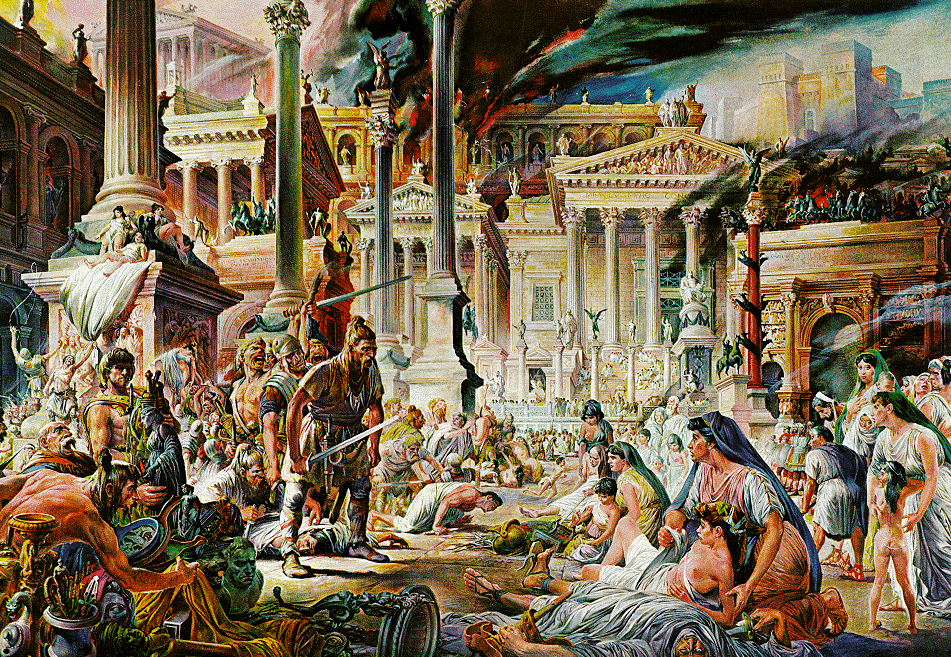
Alaric and his Visigoths, 410.  These guys had been besieging the place for quite some time, but it was part of a longer struggle between the Goths and the Emperor Honorius.  It took three days, and was pretty much just an organized looting, after which they left.  Note that by this point, Rome hadn't been the functional capital for quite some time.  The East was ruled from Constantinople, the West from various places--at this point, Ravenna.  I remember this picture from National Geographic, particularly the half-naked adolescents being offered up to the Visigoths by their mothers, though their gestures are intended to look protective.

Then came this one
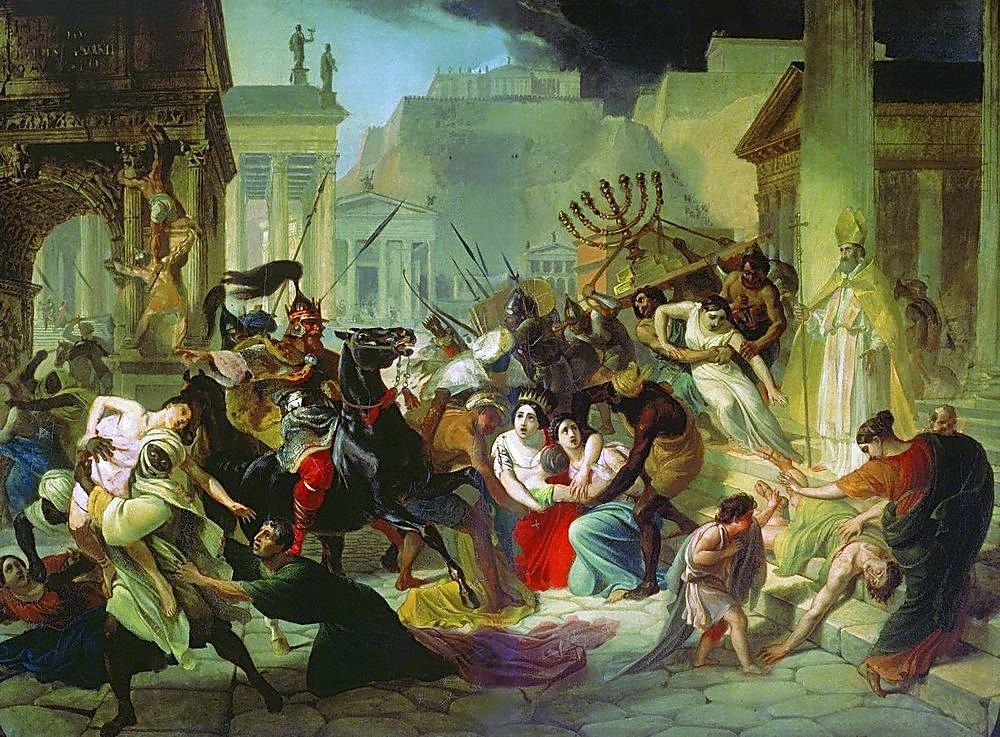
Geiseric and his Vandals, 455.  Geisiric ruled North Africa, and launched a major expedition from Carthage (almost exactly 600 years after that city's destruction by Rome) to spend a good two weeks in a systematic looting of the city.  No battle, no siege, though there was no doubt violence.  The forces were from North Africa, but Vandals were from eastern Germany, and their population mostly descendants of Phoenicians and Italians, plus desert tribes, so I'm not sure about the ethnic composition here.  And they came by ship, so I'm not sure about the horse either.  The menora was itself presumably looted from Jerusalem by Titus over 300 years earlier.  And, given how much there is to steal, I don't know why those two in the background are struggling up the victory arch: to pry out the bronze lettering?  Knock a few heads out of the relief?

Rome was already rapidly losing population because the Vandals, by capturing North Africa a couple of decades earlier, had cut off the source of its dole grain, and this comprehensive looting must have accelerated the decline.  It was pretty spectacularly depopulated from now until the later Middle Ages.

There were some later events during Justinian's unfortunately successful attempt to reconquer Italy, and the subsequent wars with the invading Lombards, but by that point there was not a lot of movable stuff left. There really is no one Sack marking the end of Roman power, and certainly nothing like that suffered by Carthage and many other victims of Roman expansion.

I think the modern vision of what happened to the Eternal City at the end of Antiquity is actually influenced by a much later Sack of Rome:  that of 1527.  Charles V's (largely German) troops looted, tortured, raped, and burned the city for months, bringing an end to its Renaissance golden age.  It was horrific, and must have seared itself into the imaginations of Europeans.  When they thought of sacks of the city by Germanic barbarian tribes, they projected the events of the dramatic recent one back, though in reality, those had been relatively orderly procedures by comparison.  Recent history influences our perception of deeper history much more than we usually realize.


Behind the boiler

Here is a copy of a piece I had in the Tor newsletter this month.  The original may be found here.


My favorite writing space in my life was a tiny room in my apartment, above the porch, just big enough for a desk and a couple of bookshelves. It was cold in the winter and hot in the summer, but it had great light and felt completely separate from the world.

Of course, at that time, I had a life kind of like that office, clean and neat and organized. I’d saved enough money to take some time off and make it as a writer.

I won’t say I failed (five novels and one short story collection), but I can’t claim to have made it big either. I got married, had children, went back to work...and went through a dry spell in my writing. It was a choice I made freely, because usually life just shows up and saying “But I’m writing!” to that knock on the door can be a mistake.

Plus, a family is a really convenient excuse for not getting writing done, though they seldom enjoy being told that.

But as the kids have gotten older and more easily neglected, I’ve had some time. I took the old desk left over from that nice well-lit office (really a door on two filing cabinets) and set it up behind the boiler in my basement. I separated myself from the washer/dryer and the play area with bookshelves, and taped geological maps of the Southwest on the walls. I set up a Writer user on my computer that has all non-writing programs blocked and has no internet access.

I didn’t quit my day job, and, in fact, worked hard to succeed at it. But, early in the mornings before going to work, and during any spare weekend time, I started writing Brain Thief.

Now, more than ten years later, Brain Thief is finally being published.

Here is what I have learned from this experience:

  • It’s the production on your worst day that determines your overall production, not your production on your best day. A succession of days with nothing written can eat any number of days with many words written, like the seven lean years devouring the seven fat years in the story of Joseph.
  • I write less than I used to, but can’t delude myself into thinking I would write twice or three times as much if I had all day to do it. I spend 23 hours looking forward to that one hour in the morning, and do my best to make it count.
  • No one wants to listen to you whine about how your desk is behind the boiler in your basement, because if that’s as romantic as your struggle gets, you can just get back in line.
  • People at your day job may find it interesting that you also write, but they won’t cut you any slack because of it (even if your desk is behind...etc.) They actually only care about the work you do for them. So you should do it as well and as honestly as you can.
  • Take a look around yourself at your day job. This is what most people do all day. Many of them are devoted to their work. All human passions eventually surface in the workplace. Shouldn’t something in your writing reflect all that? Just don’t try to caricature your ex-boss as a world-ransoming supervillain. Unless that was your organization’s actual line of work and her actual job title, in which case you don’t need advice from me.

Index cultural fossils: music and cars

An index fossil is one that lets you date a stratum, since the conditions under which it was laid down may vary, making it otherwise hard to identify.

In historical movies set in the United States after the end of WWI, popular music and cars serve the same purpose.  Other things (like radio newscasts, or a popular TV show in the background) might do the same, but their use usually requires some plot or character action.  Music and cars are everywhere.  Music has the additional benefit of generating a soundtrack which can be marketed for little additional cost.

I recently saw Me and Orson Welles, which has a fairly extensive playlist of music from around its date, 1937. 

(Short review:  okay movie, a bit obvious, great performance from Christian McKay as Welles, Zac Efron as Richard is is too pretty and is no way suitable to the adorable lit geek Gretta Adler, and James Tupper really does look like the young Joseph Cotten--but could we avoid the coming-of-age cliche of the beautiful and talented woman who dumps you for the connections offered by a powerful older man, despite your overall wonderfulness?  Maybe she dumped you because you are an annoying dweeb.  I'm saying this as a friend.  That's why you wrote the book/movie/blog post to get back at her, right?  Get over it.)

Anyway I seem to remember something about music and cars.  Oh, of course, Manhattan 1937.  The index fossil of index fossils is Benny Goodman's "Sing, Sing, Sing", so that is here, along with some other old standards.  But it isn't as bad as a Woody Allen soundtrack, which all indicate Allen's abiding fear that if we hear a tune we can't instantly identify, we will go into convulsions, bad for ticket sales.  For some reason, the one I liked best, was Jimmy Dorsey's (brother of Johnny and Latissimus) performance of  "The Music Goes Round and Round", under the credits.  Only tunes that are both 1) big pop hits, and 2) get listened to or revived later are suitable as musical index fossils.

As usual, the round-fendered cars are all gleaming and perfect, even the taxicabs.  In real life these are owned and maintained by auto enthusiasts, who don't seem interested in keeping cars in a state of arrested decay, say, five years past their prime.  And, also as usual, only cars from immediately prior to the movie year are visible.  No surviving Model T delivery truck, held together with spit and baling wire, putts by in the background.  I noticed this particularly in Hollywoodland, set across the 1950s, where every car is gleamingly perfect.  Sure, it's LA, but the seedy detective playbed by not-quite-seedy-enough Adrien Brody has a beautiful car too.


Would we accept a period movie in which the cars range from nice new ones to miserable heaps from two decades before, and a sound track of miserable novelty songs and romantic ballads by people no one ever heard from again?  Probably not:  movies are about dreams, not reality.  But it's interesting to note how close to reality different movies feel like getting.

On getting up early to work

A few years ago, a magazine article changed my life.  In the February 2002 The Atlantic, Joseph Epstein had wrote about he became an Early Riser.  I had gone back to work.  I had two children.  I was getting no work done.  And here Epstein had a straighforward solution:  get up early.

I'd always resisted that.  For me, the best time to get up is 7:15.  Early by some standards, maybe, but certainly leaving only enough time to get ready for work, and go.

Epstein's description of how he faced a similar situation inspired me.  And I did what he did:  I started to get up early.  Not quite the 5 AM he seems to easily manage:  5:30 is pretty good for me.  But that gives me the hour or more that I need to get some writing done.

I won't claim that my eyes snap open and I say "Rejoice, for this is the day the Lord has made."  There's usually some desperate negotiation between various selves, sometimes another warning bleep from the alarm.  It helps if I have a work that's going well--at some level I'm anxious to get back to it.

I weigh myself, go downstairs, turn on the coffee maker, and head down to the cellar, behind the boiler, my place of grace.  At this season I turn on the electric radiator under my desk.  I record my weight in my spreadsheet (the morning self is more obsessive than the daylight self), turn on KBPS (a Portland, Oregon classical station I started listening to because I could get their commentary-light overnight show in my morning), and switch to my Writer user (no internet access, no programs but MS Word), and get to work.

Many nights I don't get to bed early.  I stay up reading.  It makes the morning more painful, but I don't really regret it.  But, like Epstein, if I go through all that trouble and pain and then sit there staring at some inert pixels, I feel like an idiot.  I do my best to get something done.

I'm not advising this for everyone.  But, if like me, you have a life, and a job, and also the need to make your mark somehow, it's really worth a try.  Done right, it's like unconvering a new continent.  It's the discovery of uncolonized, unspoiled time.  No one else is up.  The world is quiet.  Give it a try and let me know how it goes.

And give thanks to Joseph Epstein, who inspired it all.

The only meta-resolution I need

I long ago gave up on New Years resolutions that involved improving myself.  Not that I can't stand improvement, but self-improvement is so incremental that it is not amenable to any great statement of intent.  Instead, I picked a grand meta-resolution:  to make only resolutions that involve having more fun.

I'm not alone in directing my attention to work.  That's fine and necessary:  I have a demanding day job, and write my fiction mornings and weekends.  But I sometimes neglect to have the fun that is kind of the point of being alive.  Making resolutions to do so seems a bit absurd, but I find that they pay off.  I resolve to see more movies, see more friends, and do other things I enjoy.

So today, when a friend called to take advantage of a beautiful snowfall we just had to go cross-country skiing, I did it.  I had things I could have done at home, and even had to consider it a bit, but, really, doing anything else would have been dumb.  I'll see if I can keep it up.  I never get out to the movies enough, even though I make the same resolution on that year after year.  But the meta-resolution remains.

Where I'll be at Arisia

I will be at Arisia (Cambridge, MA  Jan 15-18).  Here is my schedule, with comments:

Friday, 8 PM, The Best Science Fiction of 2009
Ian Randall Strock, Gardners Dozois, Candra Gill, James L. Cambias

People try to put me on panels like this all the time, and I always dodge, because I don't read enough SF in any given year to participate adequately.  But Gardner requested my presence, and I have obeyed.

Saturday, 2 PM, The Next -Punk
Mario Di Giacomo (moderator), Sarah Smith, Rachel Silber, Israel Peskowitz

If I can't keep up with the present, how can I discern the path of the genre in the future?  This time it is my old friend and housemate Rachel Silber who is responsible, and again I obey.

Saturday, 4 PM, Whither Hard SF?
Allen Steele, Danielle Ackley-McPhail, Stephen R Wilk, Mark L Van Name

"Whither"? In the future, all hard SF will involve archaic grammatical constructions!

Sunday, 2:30 PM, Reading
Just me.

I'll probably read from the new book, Brain Thief.  What else?


You can get anything you want, as long as it's what everyone else wants

My mother, who grew up in the Soviet Union, always said that about the United States.  So even when she came to this country, in the 50s, she was noticing the lack of a Long Tail.  This wasn't Henry Ford producing Model Ts in only black, this was a general problem of production for small market segments.

We're supposed to be over that, aren't we?  So why am I having so much trouble finding a non-widescreen monitor?  My monitor stopped working yesterday, in the middle of actual dayjob work (I don't usually work from home, but my son broke his leg and needed someone in the house with him).  A quick check with the laptop revealed a huge selection of big widescreen monitors at nice prices--one of which I eventually bought at a Staples around the corner.

I spend most of my time on this screen writing.  A widescreen gives me lines that are too long to read comfortably.  And I have no interest in having multiple windows visible--even single tasking puts a serious strain on my underpowered brain.  Surely I'm not the only one who wants this.  Why, then, is a simple portrait-orientation monitor suddenly so hard to find?

I felt the same way when, back in the days of PDAs, they all went color.  I kept addresses, dates, and other such information on it.  All color meant was that battery life went way down.  Then, with cell phones, the same thing happened.

This isn't some kind of curmudgeonly "I liked it better before" thing--at least I don't think it is.  It's a "why can't I buy it if I want it?" thing.

It's also a "is everyone else crazy?" thing.  I would have guessed the market would be split into the two types, with work-oriented people getting one, and entertainment-oriented people getting the other.  Does this show I would have failed in monitor marketing, or that I would have scored a success in an underserved market segment?

Just mark this market segment underserved.

A rose by any other name

How many articles, books, and blog posts have this as a title?  I'm not even going to google it--go ahead if you want to.

But the question is, would it smell as sweet?  More and more studies show how subject our perceptions are to context, expectation, and the inherent hacked-together nature of our sensory circuits.  We think we perceive things, but that is largely an illusion.  Sometimes this happens even when we are prepared for it:  even if you know the lines in the optical illusion are actually straight, you see them as curved.

But when Juliet goes into her semiotic discussion of Romeo's name (Romeo and Juliet, Act II Scene II) she's misleading us--part of the excitement of Romeo is that he is forbidden, a bad boy Montague.  If he changed his name, he'd be less interesting.

A company name is that way too.  It seems like no big deal--let's call ourselves something, people know how good we are at what we do, after all, it won't make much difference.  Only it can, it really can.  People, even in their professional capacities, make capricious and arbitrary decisions all the time.  They don't t hink they do, of course.  If holding something warm makes you think of a new person you meet as having a warmer personality, without your having any idea that you're being influenced, you have to know that a company's name can influence you at an unconscious level.

Now, this doesn't necessarily mean that you need to drop half a million dollars on that plausible branding company's year-long rebranding scheme, but it does mean you shouldn't take it for granted.  And you should give it the time and resources it deserves.

This is occupying a certain amount of my time at work, with a fair amount of stress.